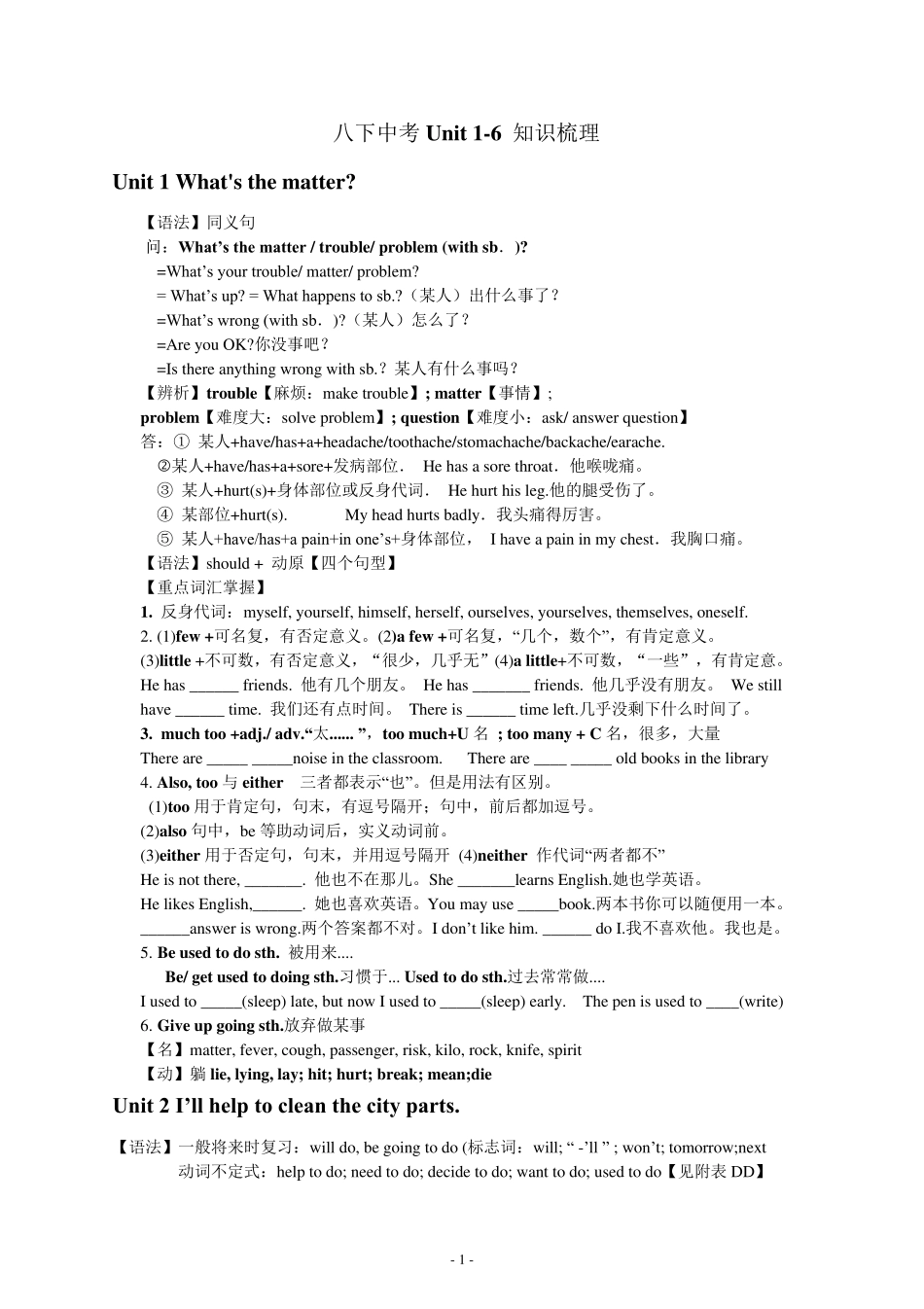
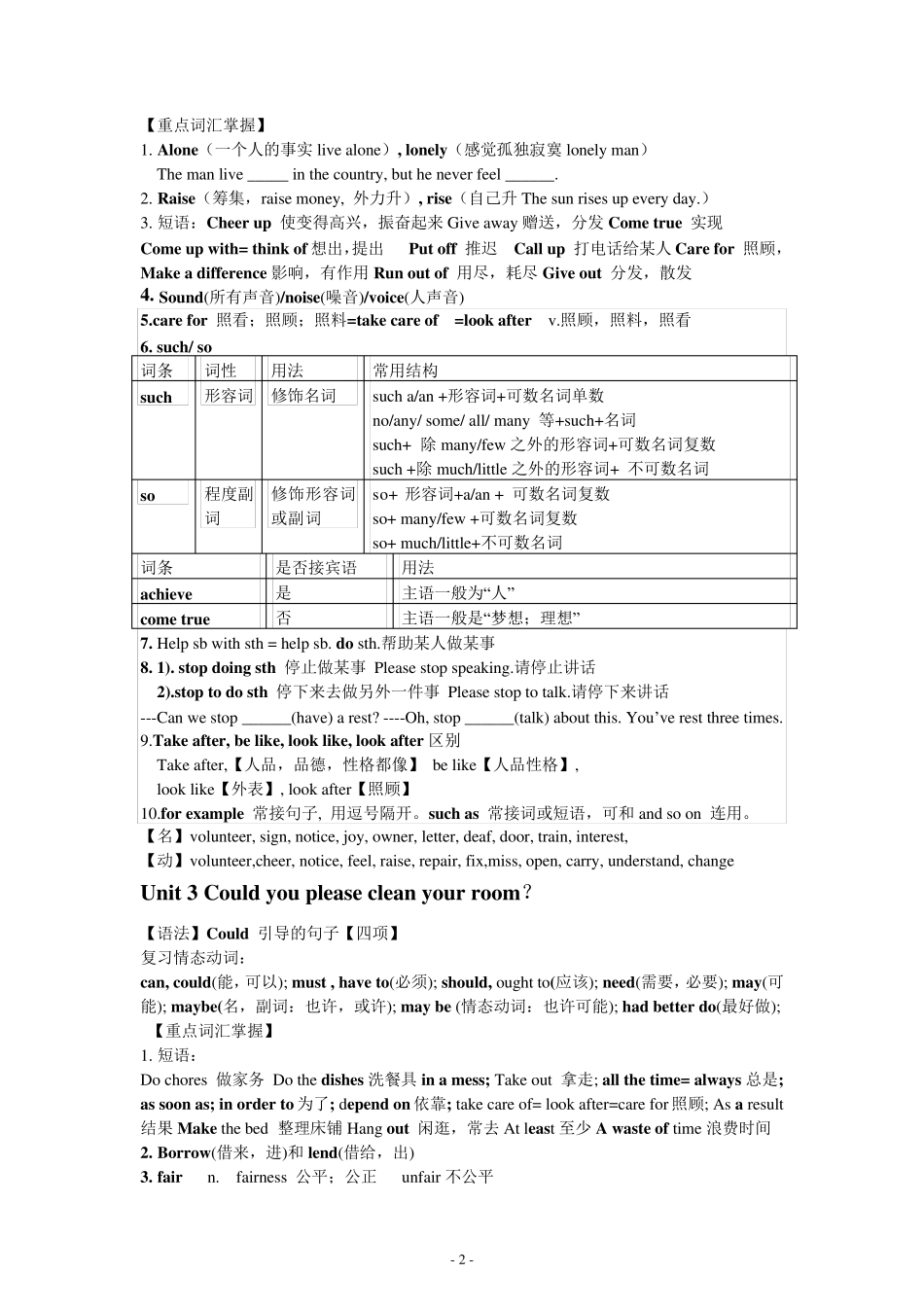
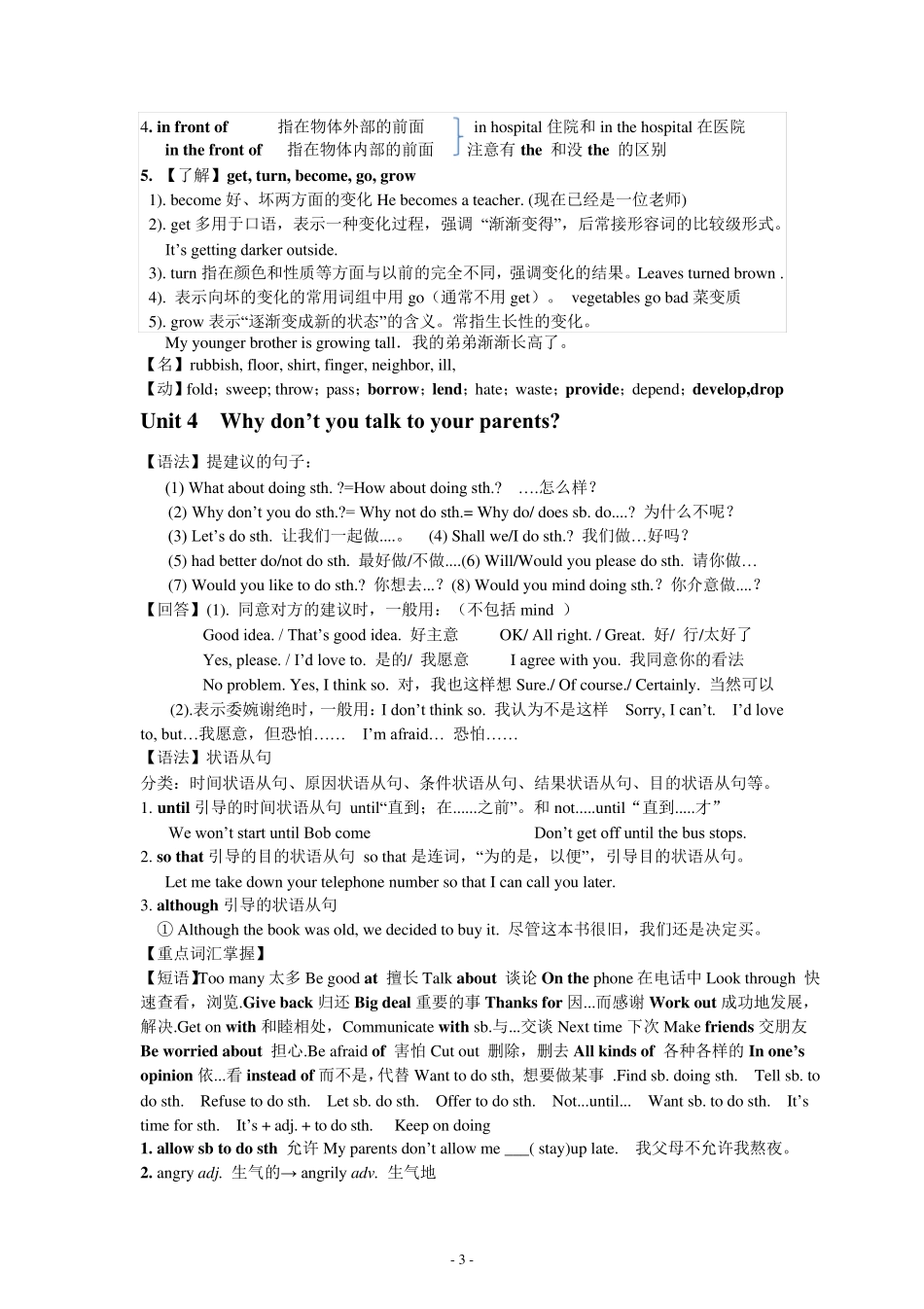
- 1 - 八下中考Unit 1-6 知识梳理 Unit 1 What's the matter? 【语法】同义句 问:What’s the matter / trouble/ problem (with sb.)? =What’s your trouble/ matter/ problem? = What’s up? = What happens to sb.?(某人)出什么事了? =What’s wrong (with sb.)?(某人)怎么了? =Are you OK?你没事吧? =Is there anything wrong with sb.?某人有什么事吗? 【辨析】trouble【麻烦:make trouble】; matter【事情】; problem【难度大:solve problem】; question【难度小:ask/ answer question】 答:① 某人+have/has+a+headache/toothache/stomachache/backache/earache. 某人+have/has+a+sore+发病部位. He has a sore throat.他喉咙痛。 ③ 某人+hurt(s)+身体部位或反身代词. He hurt his leg.他的腿受伤了。 ④ 某部位+hurt(s). My head hurts badly.我头痛得厉害。 ⑤ 某人+have/has+a pain+in one’s+身体部位, I have a pain in my chest.我胸口痛。 【语法】should + 动原【四个句型】 【重点词汇掌握】 1. 反身代词:myself, yourself, himself, herself, ourselves, yourselves, themselves, oneself. 2. (1)few +可名复,有否定意义。(2)a few +可名复,“几个,数个”,有肯定意义。 (3)little +不可数,有否定意义,“很少,几乎无”(4)a little+不可数,“一些”,有肯定意。 He has ______ friends. 他有几个朋友。 He has _______ friends. 他几乎没有朋友。 We still have ______ time. 我们还有点时间。 There is ______ time left.几乎没剩下什么时间了。 3. much too +adj./ adv.“太...... ”,too much+U 名 ; too many + C 名,很多,大量 There are _____ _____noise in the classroom. There are ____ _____ old books in the library 4. Also, too 与 either 三者都表示“也”。但是用法有区别。 (1)too 用于肯定句,句末,有逗号隔开;句中,前后都加逗号。 (2)also 句中,be 等助动词后,实义动词前。 (3)either 用于否定句,句末,并用逗号隔开 (4)neither 作代词“两者都不” He is not there, _______. 他也不在那儿。She _______learns English.她也学英语。 He likes English,______. 她也喜...