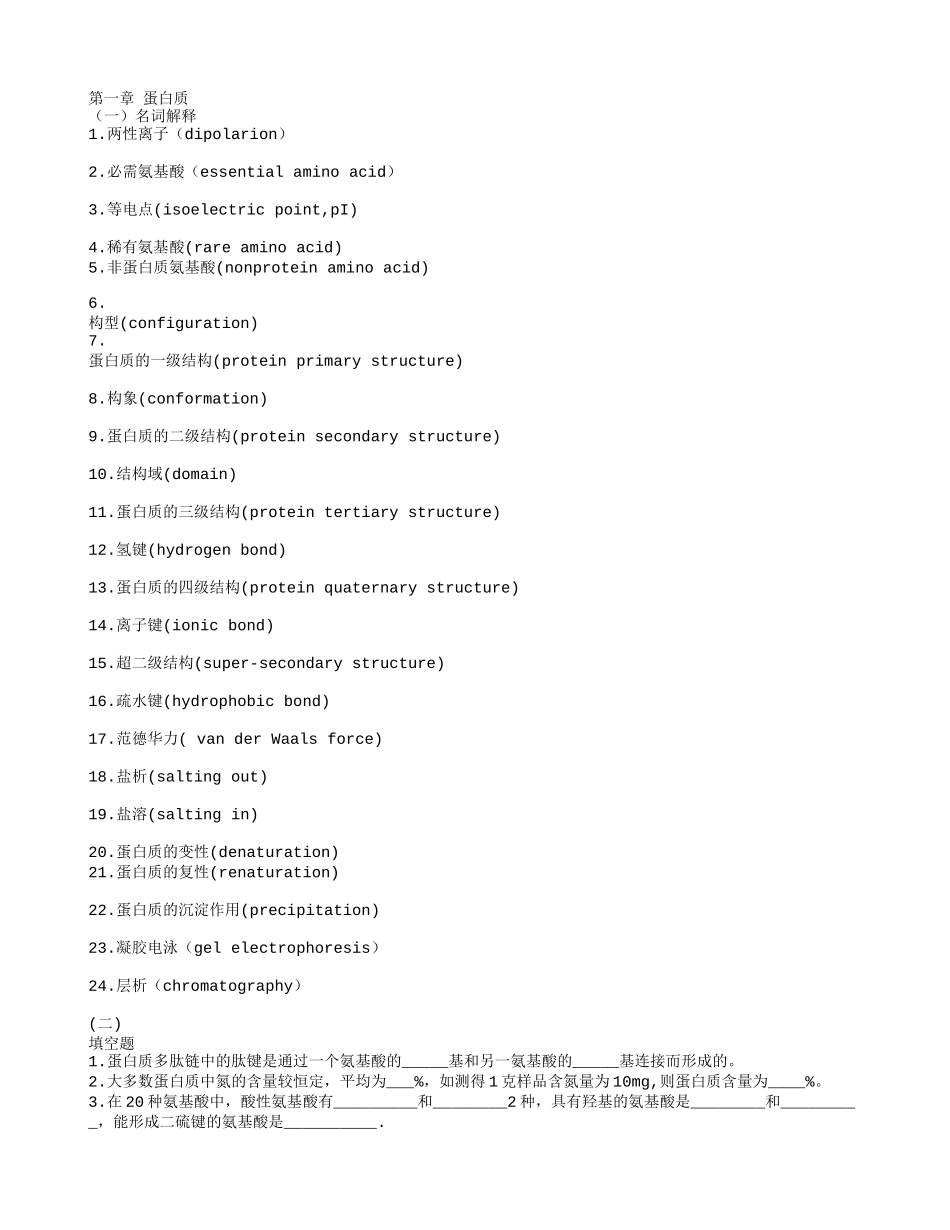
第一章蛋白质(一)名词解释1
两性离子(dipolarion)2
必需氨基酸(essentialaminoacid)3
等电点(isoelectricpoint,pI)4
稀有氨基酸(rareaminoacid)5
非蛋白质氨基酸(nonproteinaminoacid)6
构型(configuration)7
蛋白质的一级结构(proteinprimarystructure)8
构象(conformation)9
蛋白质的二级结构(proteinsecondarystructure)10
结构域(domain)11
蛋白质的三级结构(proteintertiarystructure)12
氢键(hydrogenbond)13
蛋白质的四级结构(proteinquaternarystructure)14
离子键(ionicbond)15
超二级结构(super-secondarystructure)16
疏水键(hydrophobicbond)17
范德华力(vanderWaalsforce)18
盐析(saltingout)19
盐溶(saltingin)20
蛋白质的变性(denaturation)21
蛋白质的复性(renaturation)22
蛋白质的沉淀作用(precipitation)23
凝胶电泳(gelelectrophoresis)24
层析(chromatography)(二)填空题1
蛋白质多肽链中的肽键是通过一个氨基酸的_____基和另一氨基酸的_____基连接而形成的
大多数蛋白质中氮的含量较恒定,平均为___%,如测得1克样品含氮量为10mg,则蛋白质含量为____%
在20种氨基酸中,酸性氨基酸有_________和________2种,具有羟基的氨基酸是________和_________,能形成二硫键的氨基酸是__________