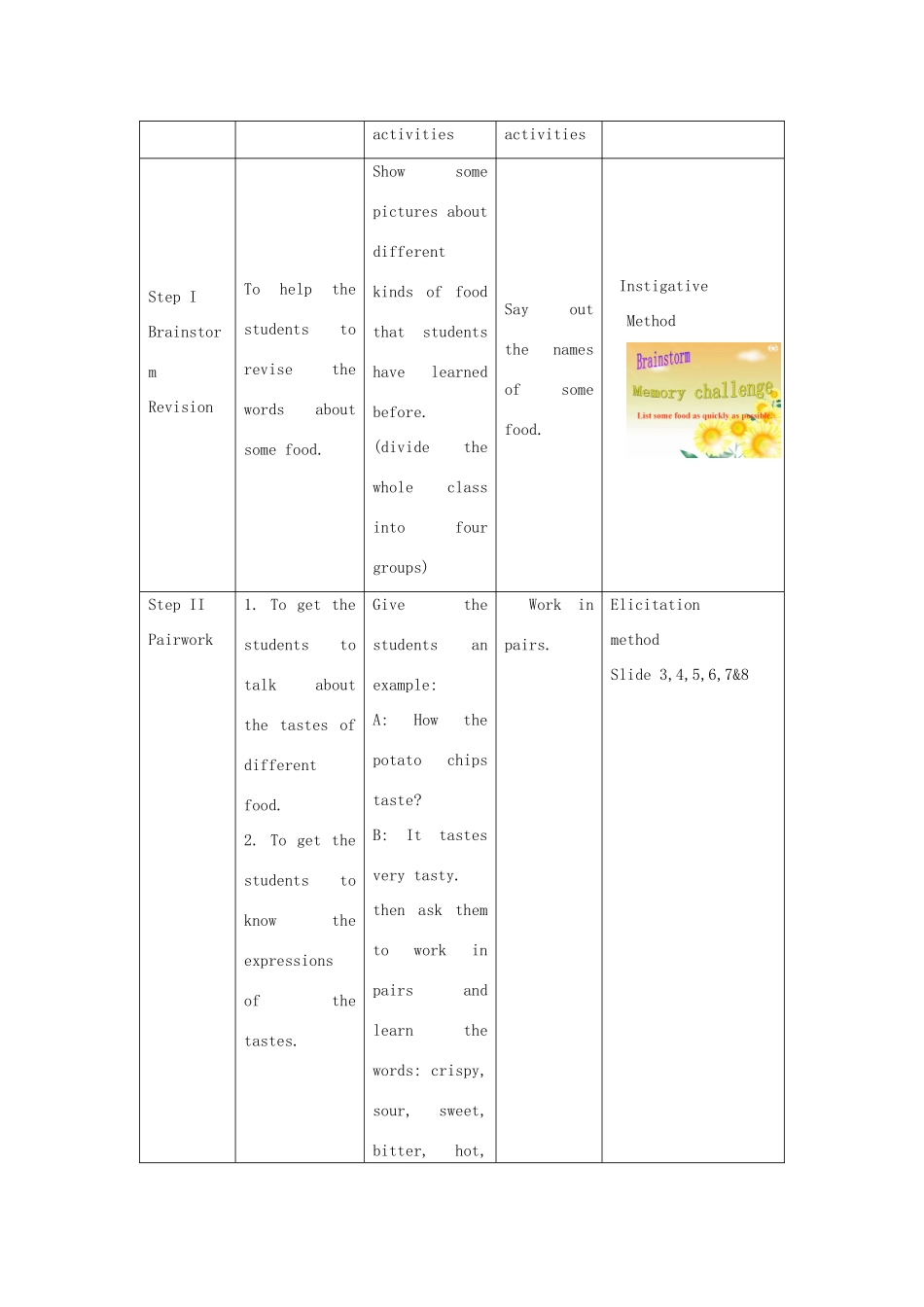
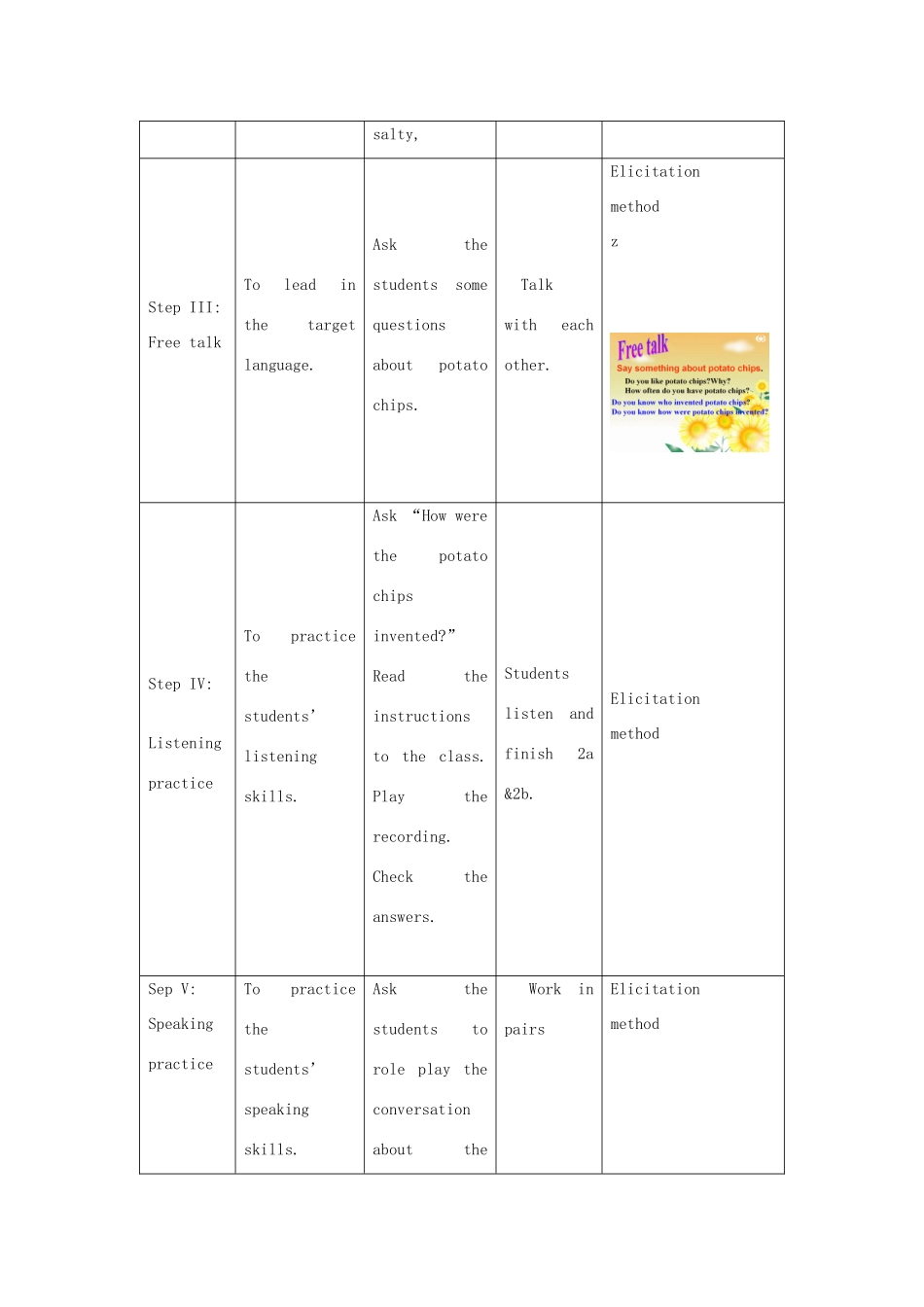
Unit9Whenwasitinvented?第三节(Period3)本节与上节相关性分析:本节课在上节课介绍各种发明物的基础上更进一步地探讨一些有关吃的东西的味道以及它们的发明史。教材提到“薯片”的发明历史,这是小孩子特别爱吃的食物,所以学生比较感兴趣。本节课是上节课的一个延伸和拓展。通过听力和口语训练,让学生自己讲述“薯片”的发明历史。最后以谈论“飞碟”的发明史从而更进一步地提高了学生会话的能力。课型:Listening&speaking时间:45minutes教材内容:SectionB1a,1b,2a,2b,2c,3b教学要求:1.Languagegoals:I.Words&expressionscrispy,sour,sweet,bitter,hot,salty,bymistake,intheend,sprinkleII.KeysentencesItwasinventedbymistake.2.Abilitygoals:Enablethestudentstousethepassivevoice.3.Emotion&attitudegoals:Enablethestudentstobeawareofdifferentinventionsaroundthem.4.Strategygoals:Enablethestudentstousewhattheyknowtoexplainnewwords.教学重点:Understandandusethenewwords,phrasesandthepassivevoicecorrectly.教学难点:Introducethehistoryofpotatochipsaccordingtothelisteningmaterials.教学方法:InstigativemethodandInstigativemethod教学手段:acomputer,blackboard,thelisteningmaterials,PPTTeachingprocedures(教学步骤)StepsAimsTeacher’sStudents’TeachingmethodsactivitiesactivitiesStepIBrainstormRevisionTohelpthestudentstorevisethewordsaboutsomefood.Showsomepicturesaboutdifferentkindsoffoodthatstudentshavelearnedbefore.(dividethewholeclassintofourgroups)Sayoutthenamesofsomefood.InstigativeMethodStepIIPairwork1.Togetthestudentstotalkaboutthetastesofdifferentfood.2.Togetthestudentstoknowtheexpressionsofthetastes.Givethestudentsanexample:A:Howthepotatochipstaste?B:Ittastesverytasty.thenaskthemtoworkinpairsandlearnthewords:crispy,sour,sweet,bitter,hot,Workinpairs.ElicitationmethodSlide3,4,5,6,7&8salty,StepIII:FreetalkToleadinthetargetlanguage.Askthestudentssomequestionsaboutpotatochips.Talkwitheachother.ElicitationmethodzStepIV:ListeningpracticeTopracticethestudents’listeningskills.Ask“Howwerethepotatochipsinvented?”Readtheinstructionstotheclass.Playtherecording.Checktheanswers.Studentslistenandfinish2a&2b.ElicitationmethodSepV:SpeakingpracticeTopracticethestudents’speakingskills.AskthestudentstoroleplaytheconversationabouttheWorkinpairsElicitationmethodinventionofpotatochips.StepVI:ExtraspeakingpracticeTopracticethestudents’speakingskills.Leadthestudentstomakeconversationabouttheinventionofflyingdisk.Workingroupsaccordingtothelisteningmaterials.InductivemethodStepVIIExerciseTohelpthestudentstopracticewhattheylearnedtoday.Showthestudentstoexercise.Finishtheexercise.InductiveandelicitationmethodStepVIIIHomework1.Retellthehistoryofpotatochips2.Writeanarticleabouttheinventionoftheflyingdisk.附一:(Blackboarddesign)G1G2G3Theemperor----wasboiling----over…正正正Someleaves----fellinto---remained…正正一Theemperornoticed---produced…一教学反思:本节课是听说课。主要是依靠口头训练,检验与促进语言的吸收与听力能力。听力材料内容是有关学生比较感兴趣的话题:薯片的发明史。大家都知道听说课就是一个对语言的感知、解析、和应用的过程。我记得美国认识心理学家安德森(Anderson)曾认为:听力理解过程可划分为三个阶段,即感知过程(perceptualprocessing)、解析过程(parsing)和应用过程(utilization)。这三个过程相互交迭、循环往复、不断修正。所以本节课在听力之前我先让学生进行一个“Freetalk”,让学生自由发挥谈论有关Potatochips的内容。这看似是一个口语活动,与听力无关,其实不然。它是听力训练中的一个重要环节。这个freetalk就是语言的感知过程。然后引出本节课的语言目标Whenwasitinvented?让学生带着问题去听,其实这是一个对语言目标的解析过程。最后再利用对话的形式(workinpairs)对Potatochips的发明史进行对话,这是对目标语言的应用。在应用过程中,输入到学生大脑中的话语意义和学生的现有知识相互联系起来,于是学生就对整个口头语篇产生丰富的先前知识,并能把先前的知识更好地组织起来,加以更策略地运用。应用过程既是对听力理解力的检测,又是对听力理解力的促进,为听力能力的进一步发展提供了可能。因此,在听力教学中必须要有口头训练来检验与促进语言的吸收与思维能力(即听力能力)的发展。唯有听的语言输入活动之后,进行必要的语言输出活动,听力教学活动才算完整、有效。所以每一节听说课都是一次很好的语言感知能力与应用能力的培养、训练过程。教师绝对要认真对待,精心设计,以优化的教学策略帮助学生养成良好的听力学习方法与习惯,促进学生听说能力的发展。