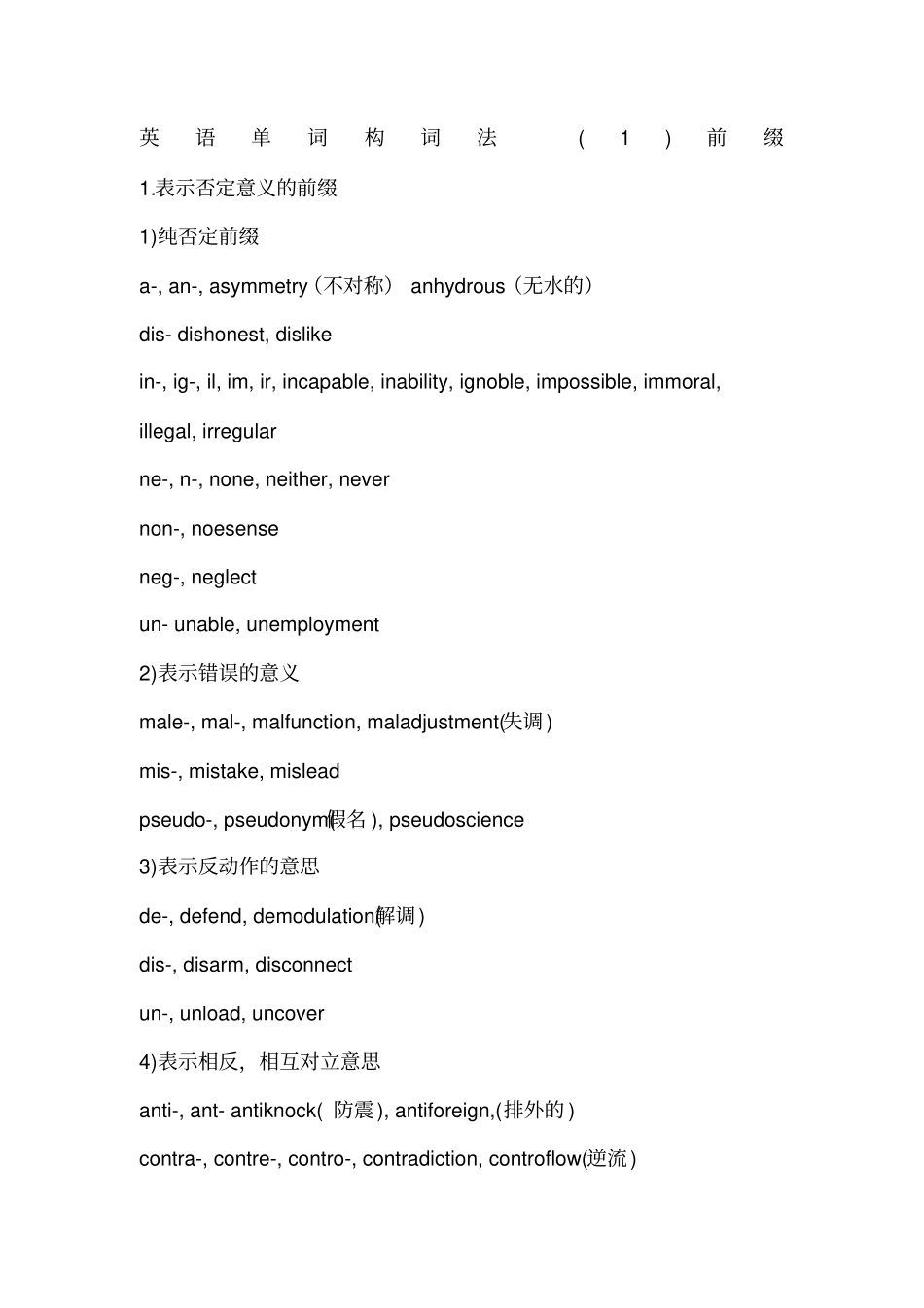
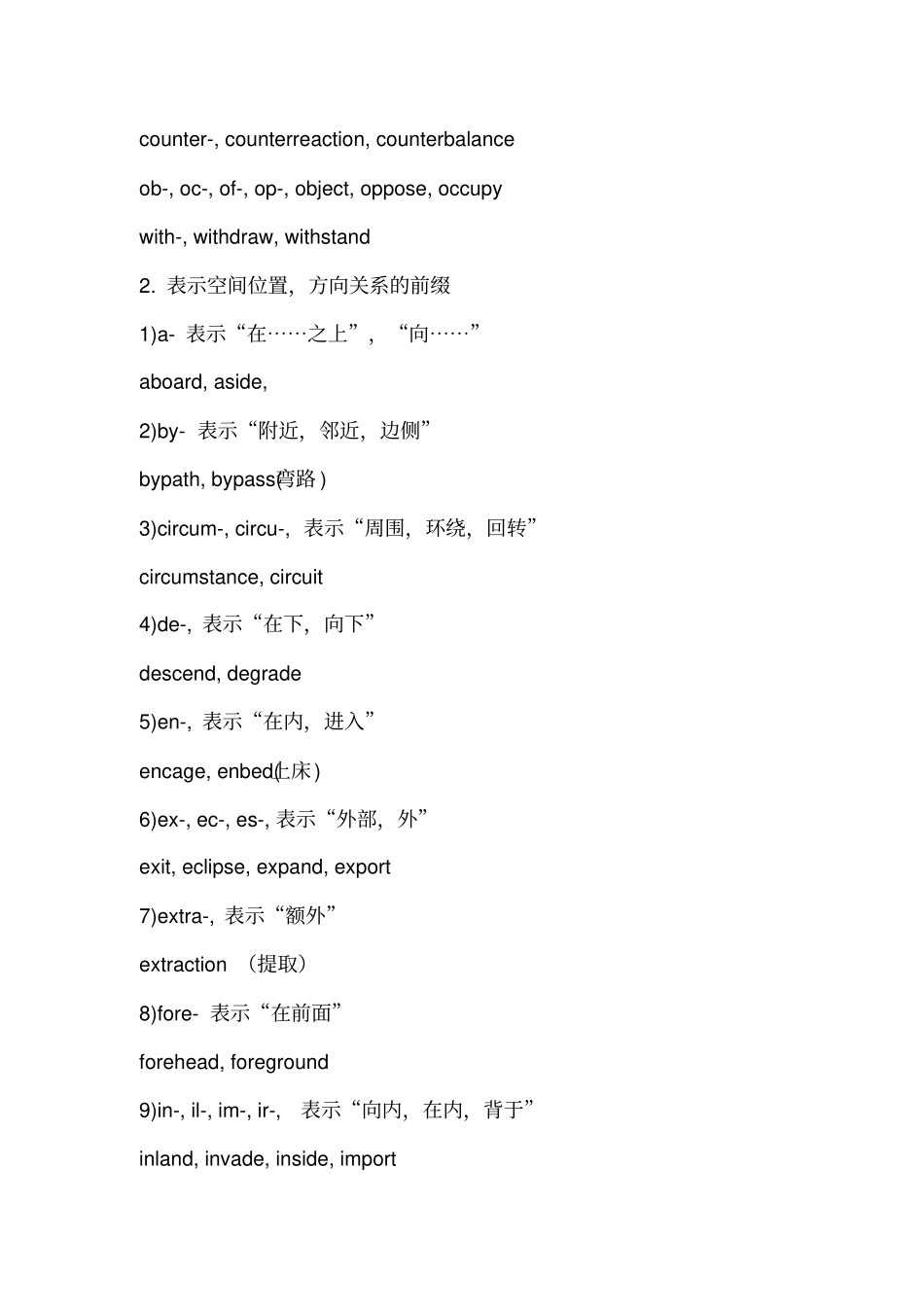
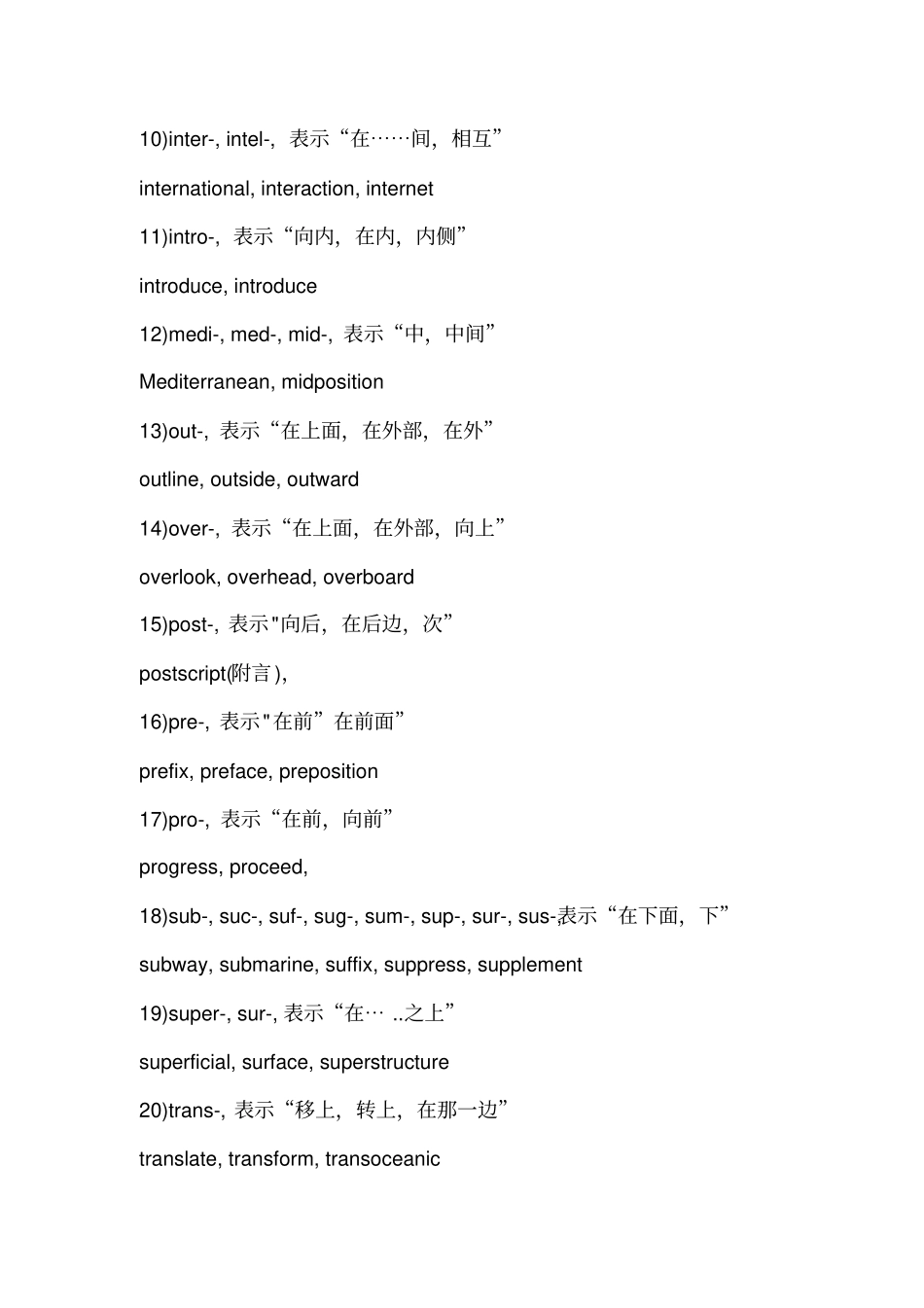
英语单词构词法(1)前缀1.表示否定意义的前缀1)纯否定前缀a-, an-, asymmetry(不对称) anhydrous(无水的)dis- dishonest, dislike in-, ig-, il, im, ir, incapable, inability, ignoble, impossible, immoral, illegal, irregular ne-, n-, none, neither, never non-, noesense neg-, neglect un- unable, unemployment 2)表示错误的意义male-, mal-, malfunction, maladjustment(失调) mis-, mistake, mislead pseudo-, pseudonym(假名 ), pseudoscience 3)表示反动作的意思de-, defend, demodulation(解调) dis-, disarm, disconnect un-, unload, uncover 4)表示相反,相互对立意思anti-, ant- antiknock( 防震), antiforeign,(排外的 ) contra-, contre-, contro-, contradiction, controflow(逆流) counter-, counterreaction, counterbalance ob-, oc-, of-, op-, object, oppose, occupy with-, withdraw, withstand 2. 表示空间位置,方向关系的前缀1)a- 表示“在⋯⋯之上”,“向⋯⋯”aboard, aside, 2)by- 表示“附近,邻近,边侧”bypath, bypass(弯路 ) 3)circum-, circu-, 表示“周围,环绕,回转”circumstance, circuit 4)de-, 表示“在下,向下”descend, degrade 5)en-, 表示“在内,进入”encage, enbed(上床) 6)ex-, ec-, es-, 表示“外部,外”exit, eclipse, expand, export 7)extra-, 表示“额外”extraction (提取)8)fore- 表示“在前面”forehead, foreground 9)in-, il-, im-, ir-, 表示“向内,在内,背于”inland, invade, inside, import 10)inter-, intel-, 表示“在⋯⋯间,相互”international, interaction, internet 11)intro-, 表示“向内,在内,内侧”introduce, introduce 12)medi-, med-, mid-, 表示“中,中间”Mediterranean, midposition 13)out-, 表示“在上面,在外部,在外”outline, outside, outward 14)over-, 表示“在上面,在外部,向上”overlook, overhead, overboard 15)post-, 表示"向后,在后边,次”postscript(附言),16)pre-, 表示"在前”在前面”prefix, preface, preposition 17)pro-, 表示“在前,向前”progress, proceed, 18)sub-, suc-, suf-, sug-, sum-, sup-, sur-, sus-, 表示“在下面,下”subway, submar...