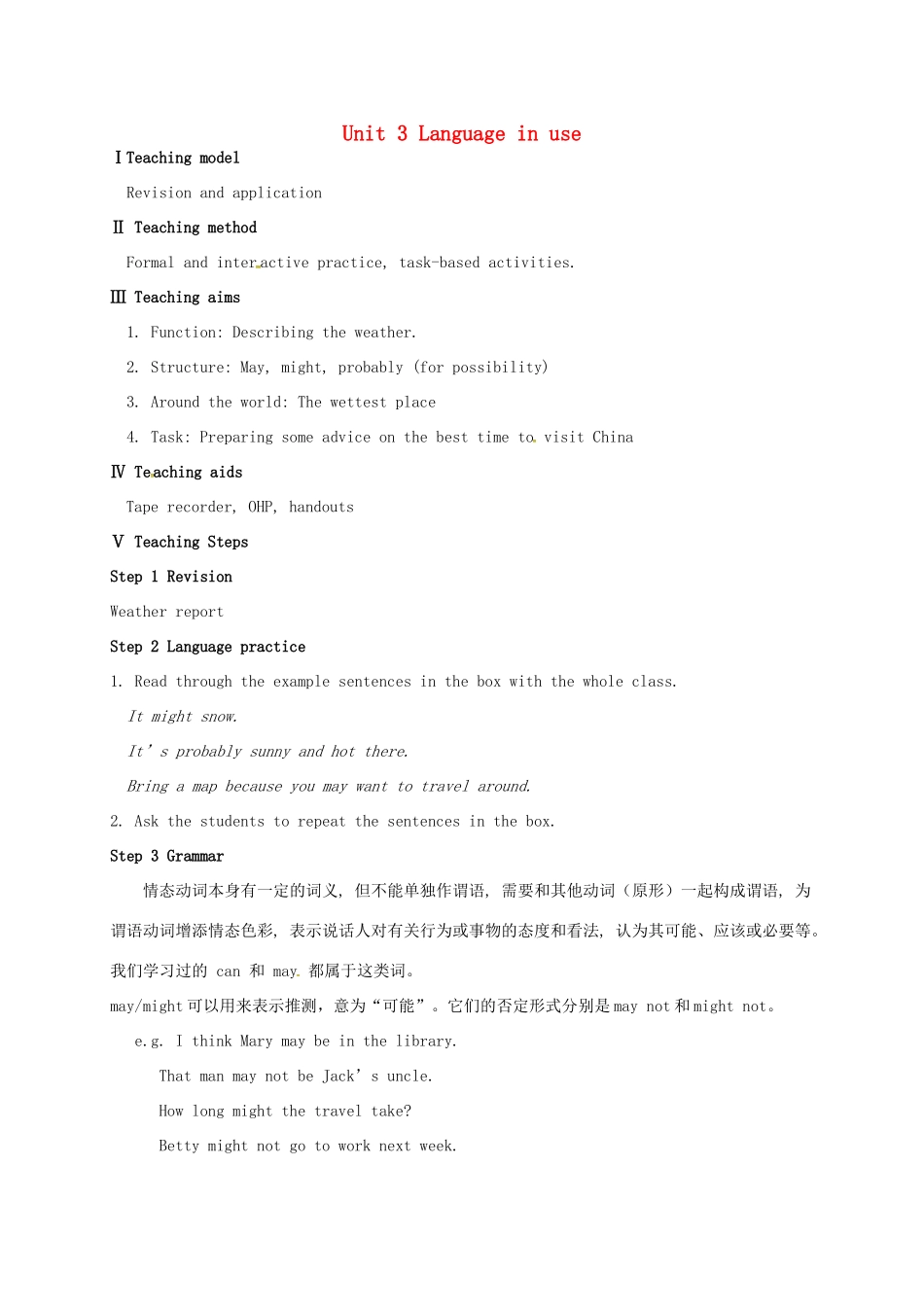
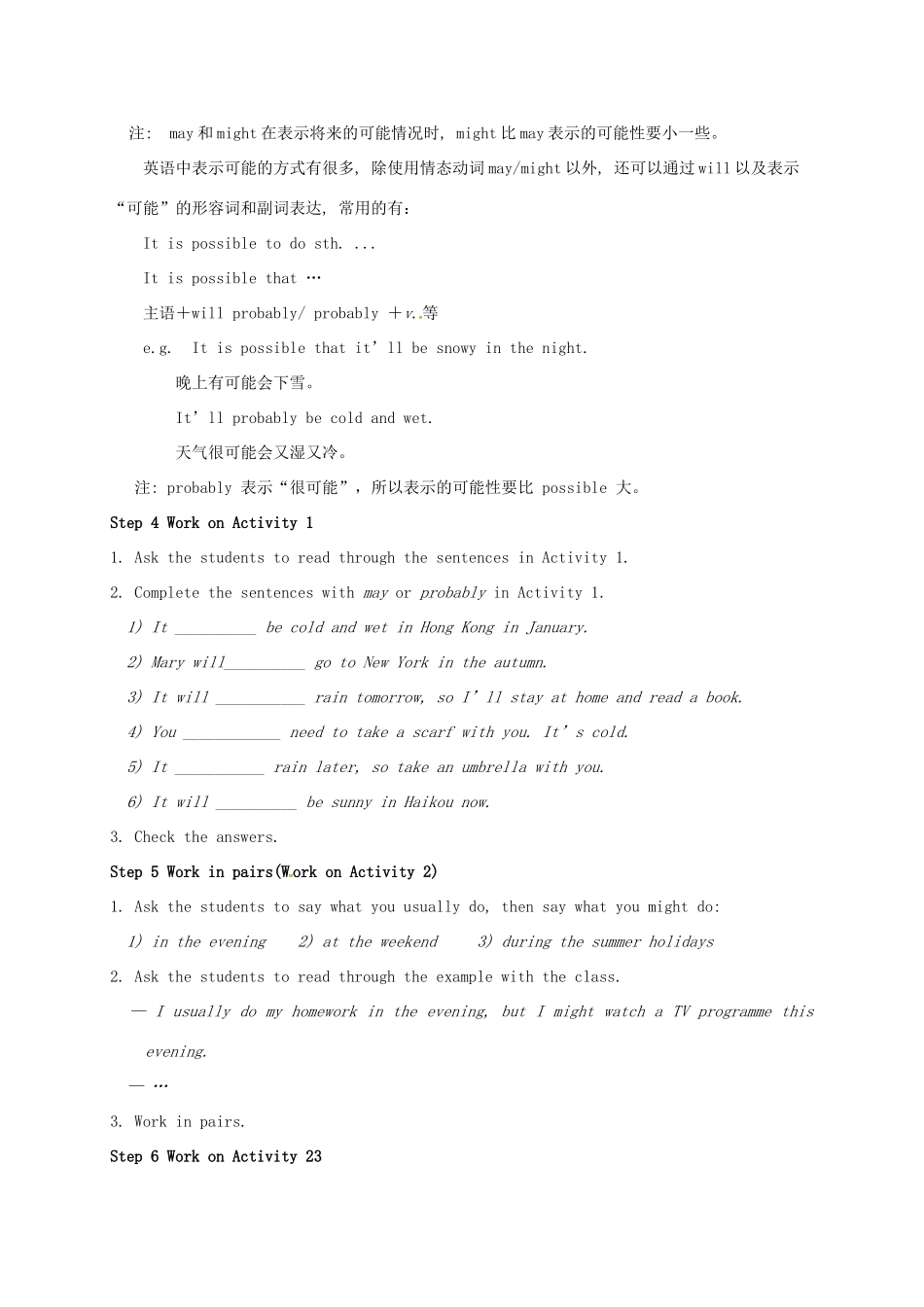
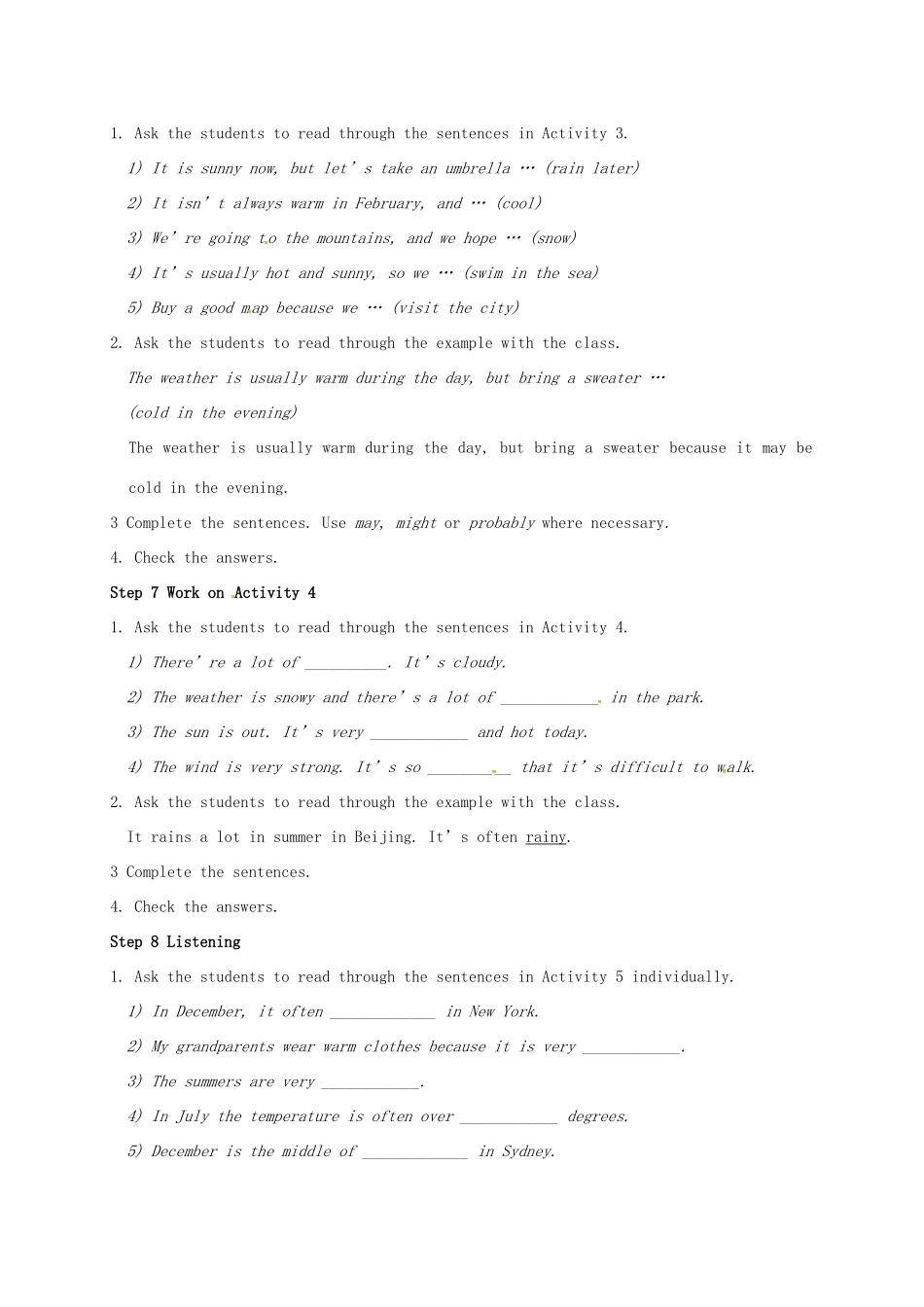
Unit3LanguageinuseⅠTeachingmodelRevisionandapplicationⅡTeachingmethodFormalandinteractivepractice,task-basedactivities.ⅢTeachingaims1.Function:Describingtheweather.2.Structure:May,might,probably(forpossibility)3.Aroundtheworld:Thewettestplace4.Task:PreparingsomeadviceonthebesttimetovisitChinaⅣTeachingaidsTaperecorder,OHP,handoutsⅤTeachingStepsStep1RevisionWeatherreportStep2Languagepractice1.Readthroughtheexamplesentencesintheboxwiththewholeclass.Itmightsnow.It’sprobablysunnyandhotthere.Bringamapbecauseyoumaywanttotravelaround.2.Askthestudentstorepeatthesentencesinthebox.Step3Grammar情态动词本身有一定的词义,但不能单独作谓语,需要和其他动词(原形)一起构成谓语,为谓语动词增添情态色彩,表示说话人对有关行为或事物的态度和看法,认为其可能、应该或必要等。我们学习过的can和may都属于这类词。may/might可以用来表示推测,意为“可能”。它们的否定形式分别是maynot和mightnot。e.g.IthinkMarymaybeinthelibrary.ThatmanmaynotbeJack’suncle.Howlongmightthetraveltake?Bettymightnotgotoworknextweek.注:may和might在表示将来的可能情况时,might比may表示的可能性要小一些。英语中表示可能的方式有很多,除使用情态动词may/might以外,还可以通过will以及表示“可能”的形容词和副词表达,常用的有:Itispossibletodosth....Itispossiblethat…主语+willprobably/probably+v.等e.g.Itispossiblethatit’llbesnowyinthenight.晚上有可能会下雪。It’llprobablybecoldandwet.天气很可能会又湿又冷。注:probably表示“很可能”,所以表示的可能性要比possible大。Step4WorkonActivity11.AskthestudentstoreadthroughthesentencesinActivity1.2.CompletethesentenceswithmayorprobablyinActivity1.1)It__________becoldandwetinHongKonginJanuary.2)Marywill__________gotoNewYorkintheautumn.3)Itwill___________raintomorrow,soI’llstayathomeandreadabook.4)You____________needtotakeascarfwithyou.It’scold.5)It___________rainlater,sotakeanumbrellawithyou.6)Itwill__________besunnyinHaikounow.3.Checktheanswers.Step5Workinpairs(WorkonActivity2)1.Askthestudentstosaywhatyouusuallydo,thensaywhatyoumightdo:1)intheevening2)attheweekend3)duringthesummerholidays2.Askthestudentstoreadthroughtheexamplewiththeclass.—Iusuallydomyhomeworkintheevening,butImightwatchaTVprogrammethisevening.—…3.Workinpairs.Step6WorkonActivity231.AskthestudentstoreadthroughthesentencesinActivity3.1)Itissunnynow,butlet’stakeanumbrella…(rainlater)2)Itisn’talwayswarminFebruary,and…(cool)3)We’regoingtothemountains,andwehope…(snow)4)It’susuallyhotandsunny,sowe…(swiminthesea)5)Buyagoodmapbecausewe…(visitthecity)2.Askthestudentstoreadthroughtheexamplewiththeclass.Theweatherisusuallywarmduringtheday,butbringasweater…(coldintheevening)Theweatherisusuallywarmduringtheday,butbringasweaterbecauseitmaybecoldintheevening.3Completethesentences.Usemay,mightorprobablywherenecessary.4.Checktheanswers.Step7WorkonActivity41.AskthestudentstoreadthroughthesentencesinActivity4.1)There’realotof__________.It’scloudy.2)Theweatherissnowyandthere’salotof____________inthepark.3)Thesunisout.It’svery____________andhottoday.4)Thewindisverystrong.It’sso__________thatit’sdifficulttowalk.2.Askthestudentstoreadthroughtheexamplewiththeclass.ItrainsalotinsummerinBeijing.It’softenrainy.3Completethesentences.4.Checktheanswers.Step8Listening1.AskthestudentstoreadthroughthesentencesinActivity5individually.1)InDecember,itoften_____________inNewYork.2)Mygrandparentswearwarmclothesbecauseitisvery____________.3)Thesummersarev...