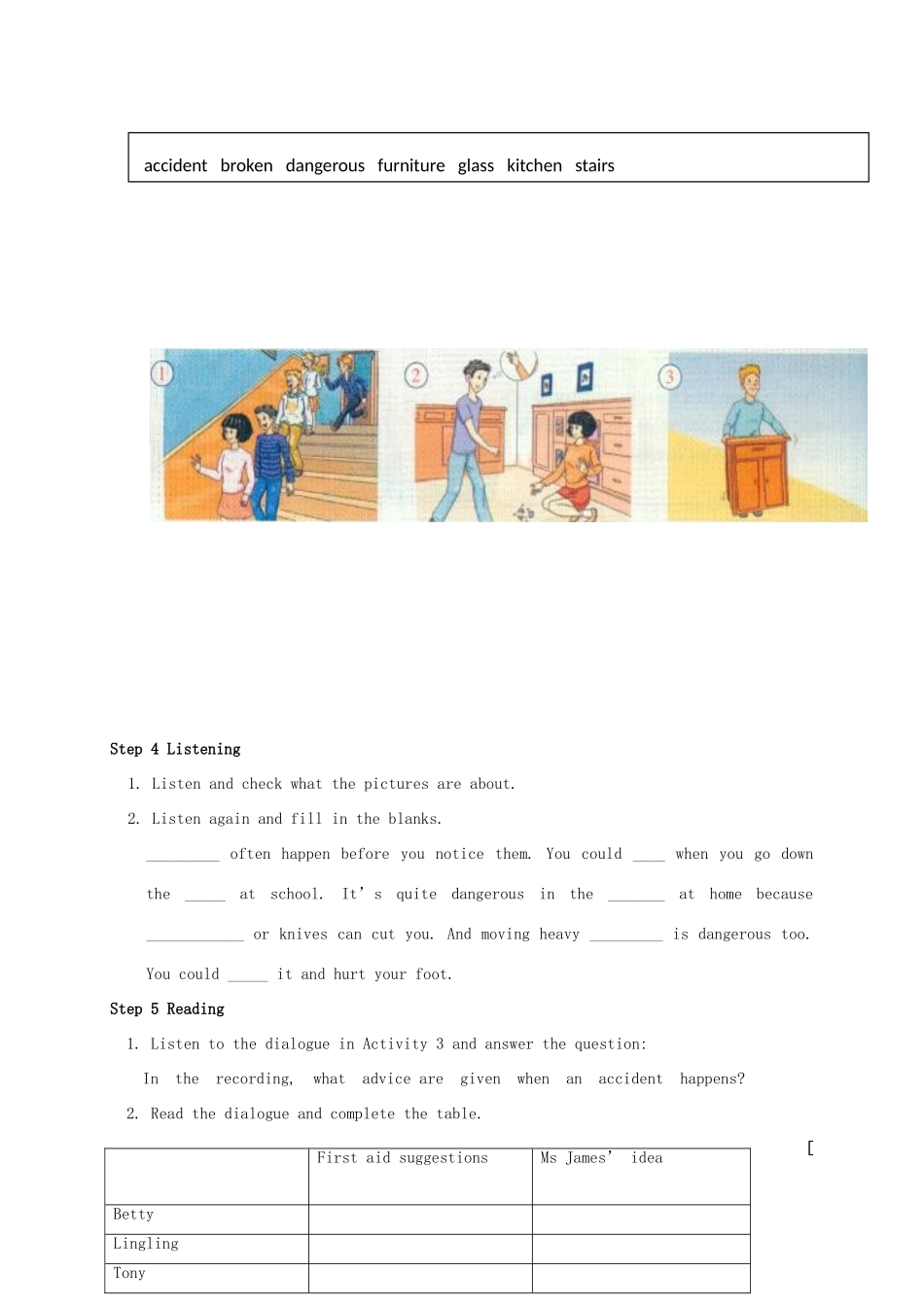
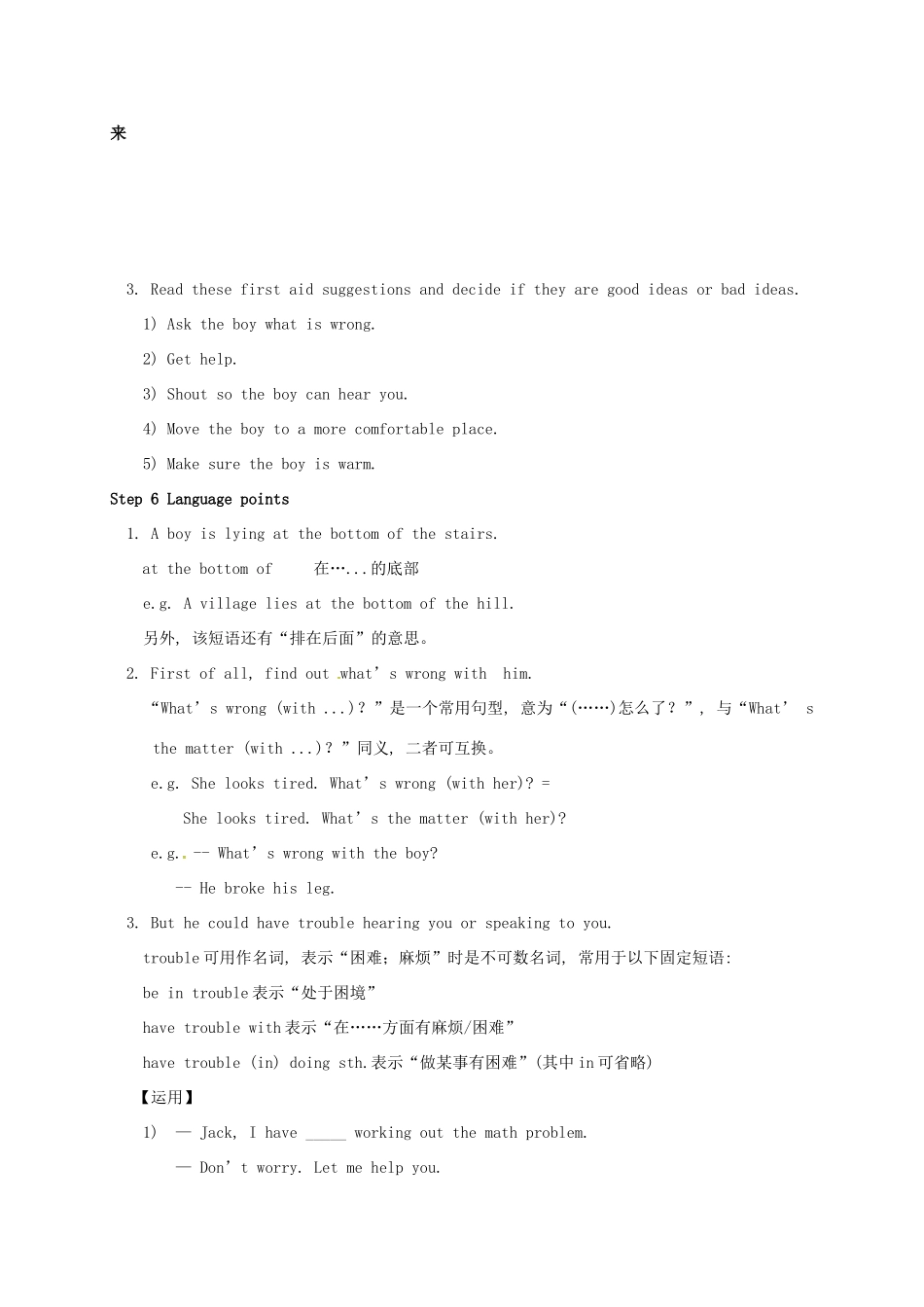
Module12HelpUnit1Whatshouldwedobeforehelparrives?【教学目标】Knowledgeobjective1.Tounderstandtheconversationinrelationtoaccidents.2.Togetspecificinformationfromthelisteningmaterial.3.Totalkaboutandunderstandtheimperativesentences.AbilityobjectiveEnablestudentstolistentoandtalkaboutthingsthatcould/can/musthappen.MoralobjectiveGetthestudentstoknowabouthowtodealwiththeaccidents.【教学重点】NewwordsandexpressionsLearntheusageofimperativesentences.【教学难点】Graspthephrasesandimportantsentences.【教学方法】PWPmethod,task-basedmethodandinteractiveapproach【教学手段】Ataperecorder,multimediaandsomepictures【教学过程】TeachingProcedures:Step1WarmingupSslookatthepictureandtalkaboutthequestion:Ifsomeoneishurtinanaccident,whatshouldyoudo?Step2PresentationTheteachershowsthepicturesofnewwordsandlearnthem.Step3WorkinpairsLetSslookatthepicturesinActivity1andtalkaboutthepicturesbyusingthewordsandexpressionsinthebox.Step4Listening1.Listenandcheckwhatthepicturesareabout.2.Listenagainandfillintheblanks._________oftenhappenbeforeyounoticethem.Youcould____whenyougodownthe_____atschool.It’squitedangerousinthe_______athomebecause____________orknivescancutyou.Andmovingheavy_________isdangeroustoo.Youcould_____itandhurtyourfoot.Step5Reading1.ListentothedialogueinActivity3andanswerthequestion:Intherecording,whatadvicearegivenwhenanaccidenthappens?2.Readthedialogueandcompletethetable.[accidentbrokendangerousfurnitureglasskitchenstairsFirstaidsuggestionsMsJames’ideaBettyLinglingTony来3.Readthesefirstaidsuggestionsanddecideiftheyaregoodideasorbadideas.1)Asktheboywhatiswrong.2)Gethelp.3)Shoutsotheboycanhearyou.4)Movetheboytoamorecomfortableplace.5)Makesuretheboyiswarm.Step6Languagepoints1.Aboyislyingatthebottomofthestairs.atthebottomof在…...的底部e.g.Avillageliesatthebottomofthehill.另外,该短语还有“排在后面”的意思。2.Firstofall,findoutwhat’swrongwithhim.“What’swrong(with...)?”是一个常用句型,意为“(……)怎么了?”,与“What’sthematter(with...)?”同义,二者可互换。e.g.Shelookstired.What’swrong(withher)?=Shelookstired.What’sthematter(withher)?e.g.--What’swrongwiththeboy?--Hebrokehisleg.3.Buthecouldhavetroublehearingyouorspeakingtoyou.trouble可用作名词,表示“困难;麻烦”时是不可数名词,常用于以下固定短语:beintrouble表示“处于困境”havetroublewith表示“在……方面有麻烦/困难”havetrouble(in)doingsth.表示“做某事有困难”(其中in可省略)【运用】1)—Jack,Ihave_____workingoutthemathproblem.—Don’tworry.Letmehelpyou.A.funB.troubleC.experience2)如果人们遇上麻烦,我们应该帮助他们。Ifpeopleare___________,weshouldhelpthem.(2015天津)3)他毫不费力就找到了我家。Hehad____________________myhouse.4.Makesurehe’swarm.makesure确保,保证e.g.Makesureyouturnoffallthelightsbeforeyougoout.IthinkIlockedthedoor,butI’llgobackandcheck,justtomakesure.5.No,thatcouldbeharmful!harmful作形容词,意为“有害的”,常构成短语beharmfulto,意为“对……有害”。如:Don’twatchTVforlong.It’sharmfultoyoureyes.【运用】吸烟对我们的健康有害,因此现在北京的所有公共场所都禁止吸烟。Smoking________________ourhealth,soBeijingstopssmokinginallpublicplacesnow.6.That’ssuchgoodadvicethatyoucouldbeadoctor,Betty!such...that...这个句型表达“如此......以至于......”的意思,such后面接名词,名词前可以有形容词修饰。如果只有形容词或副词,则要使用so...that...这一句型。e.g.Itissuchatinykitchenthatonlyonepersoncancookinit.Theyaresuchnicepeoplethatwealll...