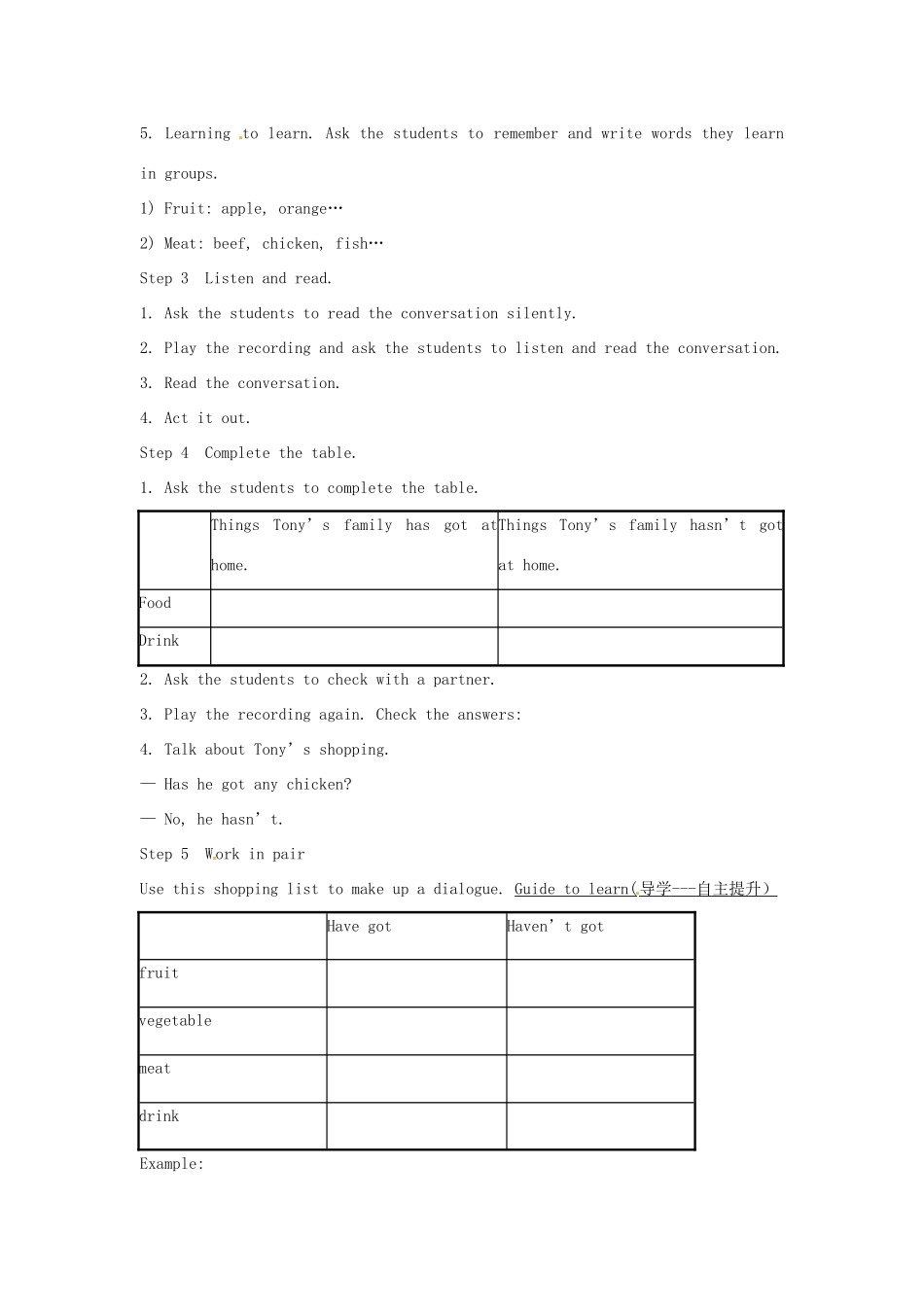
Unit1We’vegotlotsofapples.ⅠTeachingmodelListeningandspeakingⅡTeachingmethodBottom-upapproachtolisteningⅢTeachingaims1Tomasterthenewwordsandphrases.Keyvocabulary:food,drink,candy,fruit,meat,vegetable,apple,bean,beef,carrot,chicken,chocolate,coffee,cola,juice,milk,potato,tea,tomato.,water,shop,have,get,havegot,some,much,kind,so,has,badKeyphrase:goshopping,lotsof,toomuch2Tounderstandconversationsinvolvingfoodanddrink.3Totalkaboutfood.Keystructures:have/hasgotHowabout…?ⅣTeachingStepsStep1Warming-up1.Learnthenewwordsaccordingtothepronunciationbythemselves.Guidetolearn(导学---自主学习)2.Showsomepicturesoffoodanddrink.Saywhattheyare.3.Guessinggame.4.Activity1.Lookatthepictures.Labelthefoodanddrink.5.Lookatthefridge,andtellwhatwehavegot.Havewegot…?---Yes,wehave./No,wehaven’t.Wehavegot…Step2ListeningpracticeGuidetolearn(导学---启导精思)1.Askthestudentstolistentotherecordingandfocusontheshoppinglist.2.Playtherecordingagain,thentheycanchecktheiranswerwithapartner.3.Check(√)thefoodanddrinkBettyandhermotherhavegot.4.Callbacktheanswerfromthewholeclassandchecktheanswer.5.Learningtolearn.Askthestudentstorememberandwritewordstheylearningroups.1)Fruit:apple,orange…2)Meat:beef,chicken,fish…Step3Listenandread.1.Askthestudentstoreadtheconversationsilently.2.Playtherecordingandaskthestudentstolistenandreadtheconversation.3.Readtheconversation.4.Actitout.Step4Completethetable.1.Askthestudentstocompletethetable.ThingsTony’sfamilyhasgotathome.ThingsTony’sfamilyhasn’tgotathome.FoodDrink2.Askthestudentstocheckwithapartner.3.Playtherecordingagain.Checktheanswers:4.TalkaboutTony’sshopping.—Hashegotanychicken?—No,hehasn’t.Step5WorkinpairUsethisshoppinglisttomakeupadialogue.Guidetolearn(导学---自主提升)HavegotHaven’tgotfruitvegetablemeatdrinkExample:A:Whatvegetable/fruit…havewegot?B:Wehavegot…A:Havewegotany….?B:Yes,wehave./No,wehaven’t.We’vegotsome…..Butwehaven’tgotany…Step6Importantanddifficultpoints.A.重点短语:1.have/hasgot拥有2.goshopping去买东西;去购物3.let’sdosth.让我们去做某事4.toomuch太多5.toomany太多6.lotsof许多7.begoodfor对……有益8.bebadfor对……有害9.Howabout…?……好吗?……行吗?B.重要知识点:1.some和any的用法1)some和any既可以修饰可数名词又可以修饰不可数名词,some常用在肯定句中,而any则常用在否定和疑问句中。所以,some和any的区别在于:some和any的用法主要是考虑用在肯定句、疑问句还是否定句中,与名词的可数与否无关。2)some的用法:some意为“一些”,可作形容词和代词。它常修饰可数名词复数。如:somebooks一些书,someboys一些男孩,也可修饰不可数名词,如:somewater一些水,sometea一些茶叶,some常用在肯定句中。3)any的用法:any意为“任何一些”,它也可修饰可数名词复数或不可数名词,常用于疑问句和否定句。如:Ihavesometeahere.我这儿有些茶叶。Ican’tseeanytea.我没看见茶叶。Doyouhaveanyfriendsatschool?你在学校有些朋友吗?4)但在表示建议,反问,请求的疑问句中,或期望得到肯定回答时,多用some而不用any。如:Wouldyoulikesomecoffee?你要不要来点咖啡?Howaboutsomefruitjuice?来点水果汁如何?5)当any表示“任何”的意义,起强调作用时,它可以用在肯定句中;Anystudentcananswerthisquestion.任何学生都可以回答这个问题。2.many,much,lotsof的用法:1)many许多用来修饰可数名词,例如:Aretheremanystudentsinhisclass?他的班上有很多学生吗?Ihaven’tgotmanyEnglishbooks.我没有很多英语书。2)much许多用来修饰不可数名词,例如:Wehaven’tgotmuchworktodo.我们没有太多工作要做。Istheremuchmilkinthebottle?瓶子里有很多牛奶吗?3)lotsof=alotof许多它既可以修饰可数名词,相当于many;也可以修饰不可数名词,相当于much,例如:Therearelotsofapplesonthedesk.桌子上有很多苹果。Wehavegotlotsofmeatathome.我们家里有许多肉。3.toomuch和toomany的用法:toomuch和toomany都表示“太多”。1)toomuch+不可数名词,例如:Wehavetoomuchworktodo.我们有太多的工作要做。2)toomany+可数名词,例如:Therearetoomanystudentsinourclass.我们班上有太多的学生。Step9Doexercises: