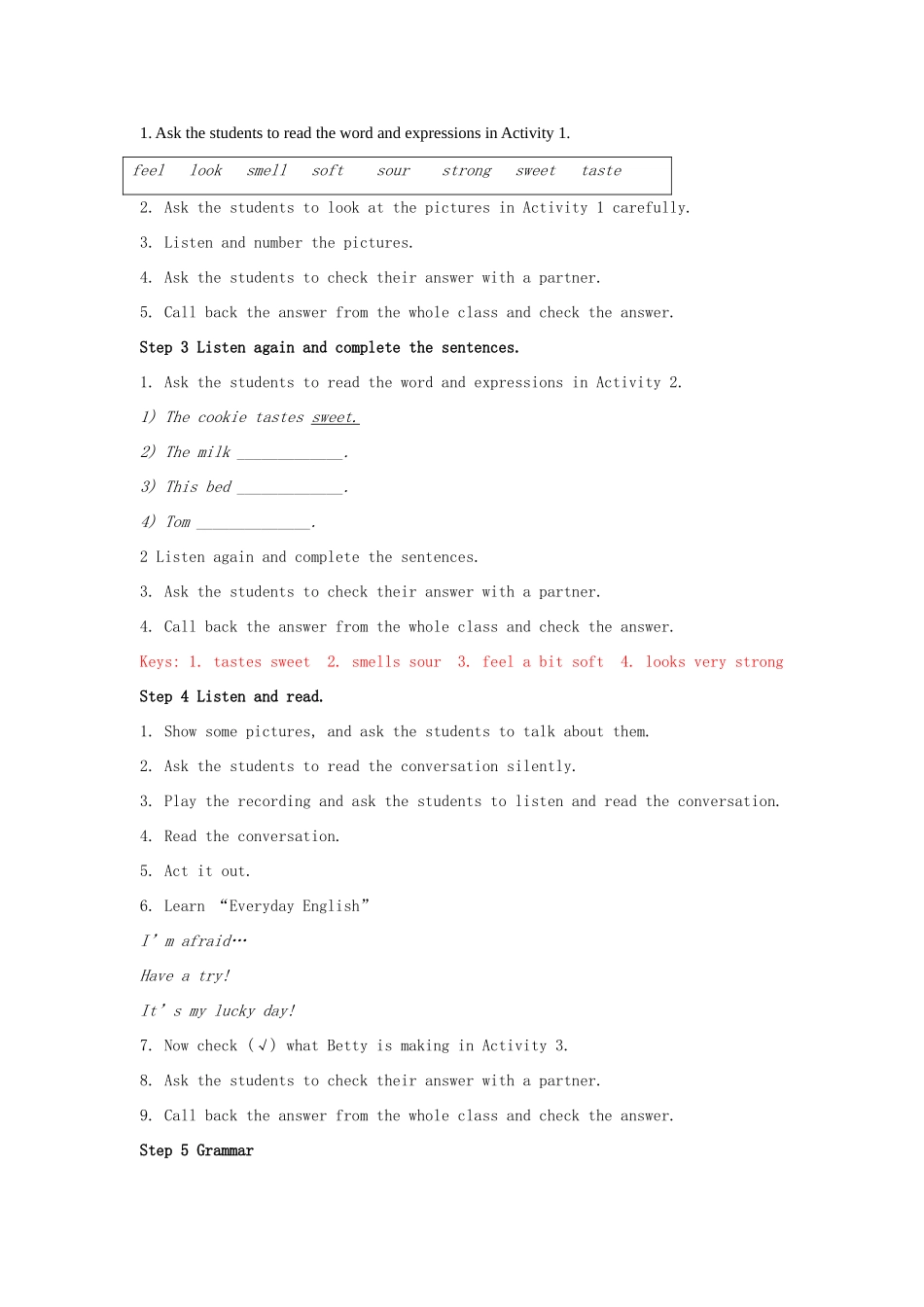
Module1Feelingsandimpressions一、学习目标:A.单词和短语:smell-smelled-smelled(smelt-smelt),soft,sour,mm,cookie,pizza,lovely,done,try,haveatry,pie,sound,sweettooth,salt,jam,for,favorite,ear,glasses,jeans,nervous,fair,pretty,proud,beproudof,stranger,message,sb.can’twait,hobby,atschool,in,mark,loveB.交际用语:1.I’mafraid…2.Haveatry!3.It’smyluckyday!4.Itsmellstoostrongandittastesabitsour.5.Theytastereallysweetandtheyfeelsoftinthemiddle.6.—Doyoulikebananas?—Yes,Ido.Theytastedelicious.Doyoulikeflowers?7.Ittastesgood.8.Itdoesn’tsmellfresh.9.Youlookverypretty.10.Igetbadmarksatschool,andIfeelsad.11.IoftenfeelabitsadatfirstwhenIleavemymumanddadforafewdays.12.I’mquiteshywhenI’mwithstranger.13.IfeelnervouswhenIspeakChinese.14.I’malwayssorrywhenIdon’tknowhowtodothingsintherightway.15.I’mafraidofflying.二.教学目标1.Function:Describingfeelingsandimpressions.2.Structure:Senseverbs:feel,look,sound,smell,taste,adjectives3.Skills:1)Listeningforspecificinformation;matchingsentenceswithpictures.2)Talkingaboutlikesanddislike.3)Readingandunderstandingbehaviorofcharacters;findingspecificinformation4)Writingadescriptionofaclassmate.4.Aroundtheworld:Politeexpressions5.Task:Writingadescriptionofaclassmate.三、重点及难点:Senseverbs:feel,look,sound,smell,taste,adjectives四、教学设计:Unit1Itsmellsdelicious.ⅠTeachingmodelListeningandspeakingⅡTeachingmethodPWPapproachⅢTeachingaims1.Tolistenandunderstandsentenceswithsenseverbs.2.Tounderstandtheconversation.3.Tolearntousesenseverbs.ⅣTeachingObjectives1.Keyvocabulary:smell-smelled-smelled(smelt-smelt),soft,sour,mm,cookie,pizza,lovely,done,try,haveatry,pie,sound,sweettooth,salt,jam,for,favorite,ear2.Keystructures:Senseverbs:feel,look,sound,smell,taste,adjectivesⅤTeachingaidsTaperecorder,OHP,videoⅥTeachingStepsStep1Warmingup1.Showsomepicturestointroducethesenseverbs.2.Showsomepicturestointroducethenewwords.3.Learnthenewwords.Step2Listenandnumberthepictures.1.AskthestudentstoreadthewordandexpressionsinActivity1.feellooksmellsoftsourstrongsweettaste2.AskthestudentstolookatthepicturesinActivity1carefully.3.Listenandnumberthepictures.4.Askthestudentstochecktheiranswerwithapartner.5.Callbacktheanswerfromthewholeclassandchecktheanswer.Step3Listenagainandcompletethesentences.1.AskthestudentstoreadthewordandexpressionsinActivity2.1)Thecookietastessweet.2)Themilk_____________.3)Thisbed_____________.4)Tom______________.2Listenagainandcompletethesentences.3.Askthestudentstochecktheiranswerwithapartner.4.Callbacktheanswerfromthewholeclassandchecktheanswer.Keys:1.tastessweet2.smellssour3.feelabitsoft4.looksverystrongStep4Listenandread.1.Showsomepictures,andaskthestudentstotalkaboutthem.2.Askthestudentstoreadtheconversationsilently.3.Playtherecordingandaskthestudentstolistenandreadtheconversation.4.Readtheconversation.5.Actitout.6.Learn“EverydayEnglish”I’mafraid…Haveatry!It’smyluckyday!7.Nowcheck(√)whatBettyismakinginActivity3.8.Askthestudentstochecktheiranswerwithapartner.9.Callbacktheanswerfromthewholeclassandchecktheanswer.Step5Grammar感官系动词:英语动词中,有的后面要接名词或代词等作宾语,有的单独作谓语,而有的后面要接形容词或名词等做主语的补充成分。我们把后面接主语补充成分的动词称为系动词。最常用的系动词是be,另外还有很多感官动词,如:look,taste,feel,smell,sound等。例如:Thefilmisinteresting.Thecookiessmelldelicious.Thesouptastestoosalty...