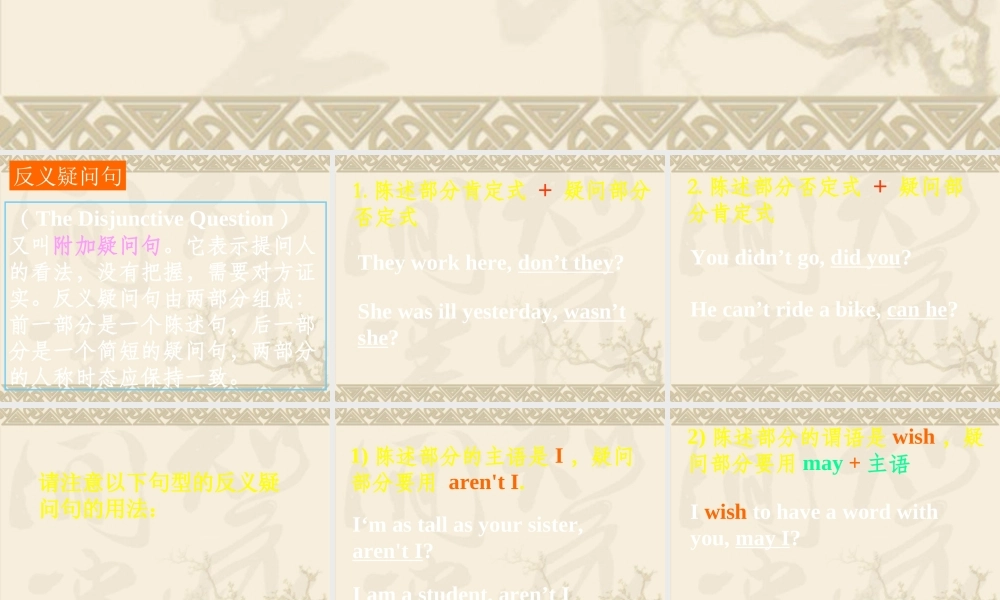
( The Disjunctive Question )又叫附加疑问句
它表示提问人的看法,没有把握,需要对方证实
反义疑问句由两部分组成:前一部分是一个陈述句,后一部分是一个简短的疑问句,两部分的人称时态应保持一致
反义疑问句1
陈述部分肯定式 + 疑问部分否定式They work here, don’t they
She was ill yesterday, wasn’t she
陈述部分否定式 + 疑问部分肯定式You didn’t go, did you
He can’t ride a bike, can he
请注意以下句型的反义疑问句的用法:1) 陈述部分的主语是 I ,疑问部分要用 aren't I
I‘m as tall as your sister, aren't I
I am a student, aren’t I2) 陈述部分的谓语是 wish ,疑问部分要用 may + 主语 I wish to have a word with you, may I
3) 陈述部分用 no, nothing, nobody, never, few, seldom, hardly, rarely, little 等否定含义的词时,疑问部分用肯定含义
The Swede made no answer, did he / she
Some plants never blown ( 开花 ), do they
There are few apples in the basket, are there
He can hardly swim, can he
They seldom come late, do they
She rarely speaks to you in English, does she
4) 含有 ought t