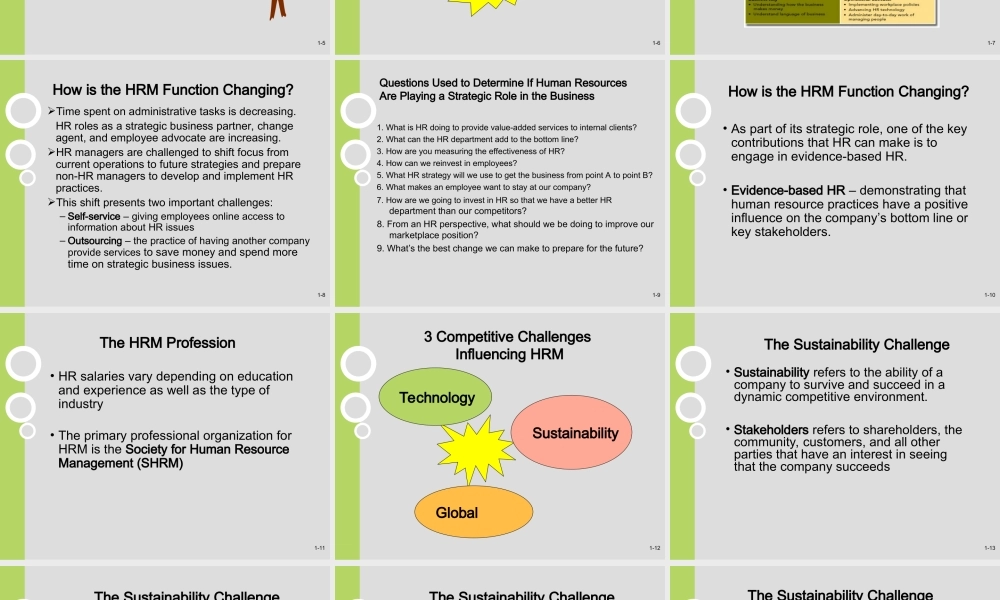
Human Resource Management:Gaining a Competitive AdvantageChapter 1Human Resource Management: Gaining a Competitive AdvantageCopyright © 2010 by the McGraw-Hill Companies, Inc. All rights reserved.McGraw-Hill/IrwinLearning Objectives•Discuss roles and activities of a company’s HRM function•Discuss implications of the economy, makeup of the labor force, and ethics for company sustainability•Discuss how HRM affects a company’s balanced scorecard•Discuss what companies should do to compete in the global marketplace•Identify the characteristics of the workforce and how they influence HRM•Discuss HRM practices that support high-performance work systems•Provide a brief description of HRM practices1-2Introduction• Competitiveness – a company’s ability to maintain and gain market share• Human resource management – the policies, practices, and systems that influence employees’ behavior, attitudes, and performance.1-3Human Resource Management Practices1-4Responsibilities of HR Departments1. Employment and Recruiting2. Training and Development3. Compensation4. Benefits5. Employee Services6. Employee and Community Relations7. Personnel Records8. Health and Safety9. Strategic Planning1-5HR as a Business with 3 Product LinesAdministrativeServices and TransactionsBusiness Partner ServicesStrategic PartnerHumanResources1-66 Competencies for the HR Profession1-7How is the HRM Function Changing?Time spent on administrative tasks is decreasing.HR roles as a strategic business partner, change agent, and employee advocate are increasing.HR managers are challenged to shift focus from current operations to future strategies and prepare non-HR managers to develop and implement HR practices.This shift presents two important challenges:– Self-service – giving...