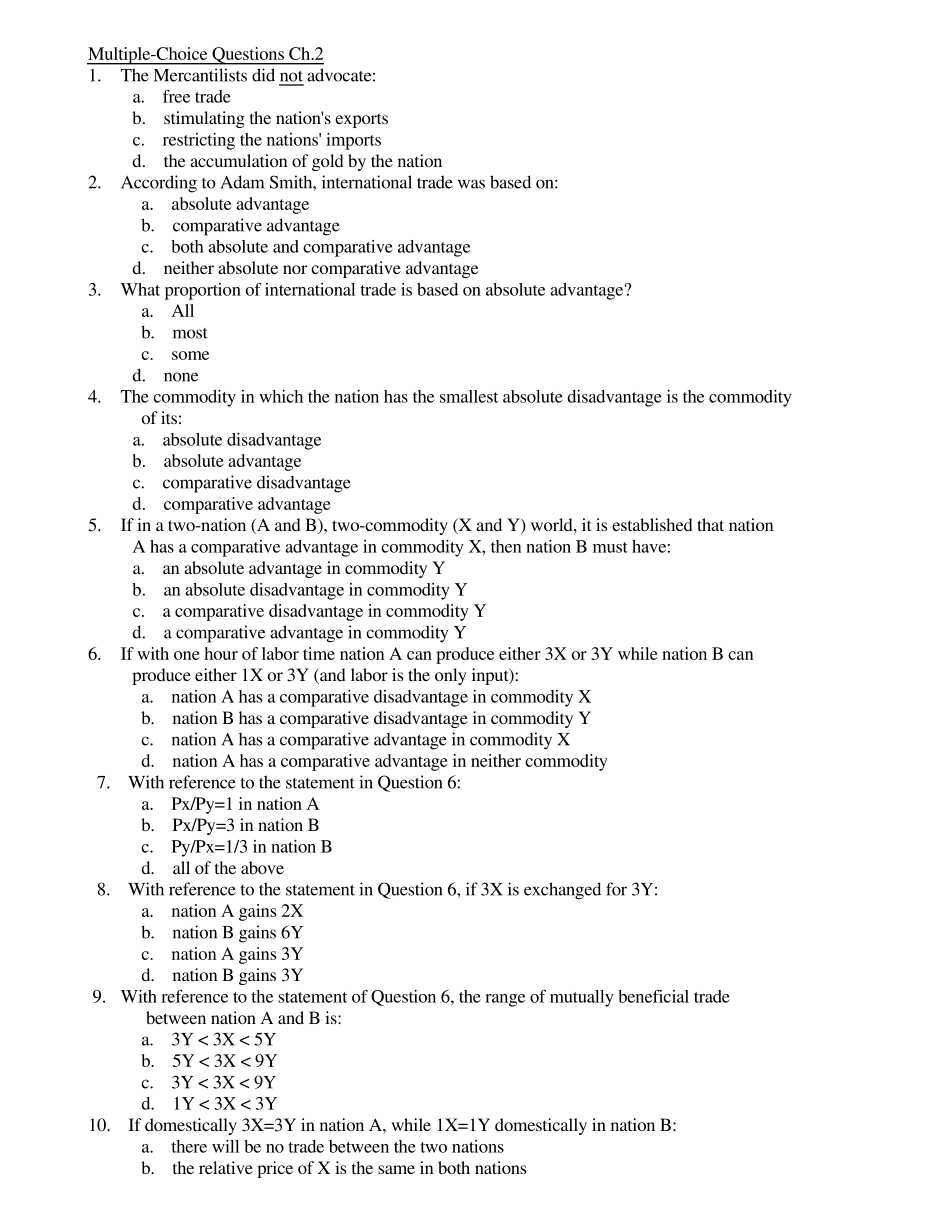
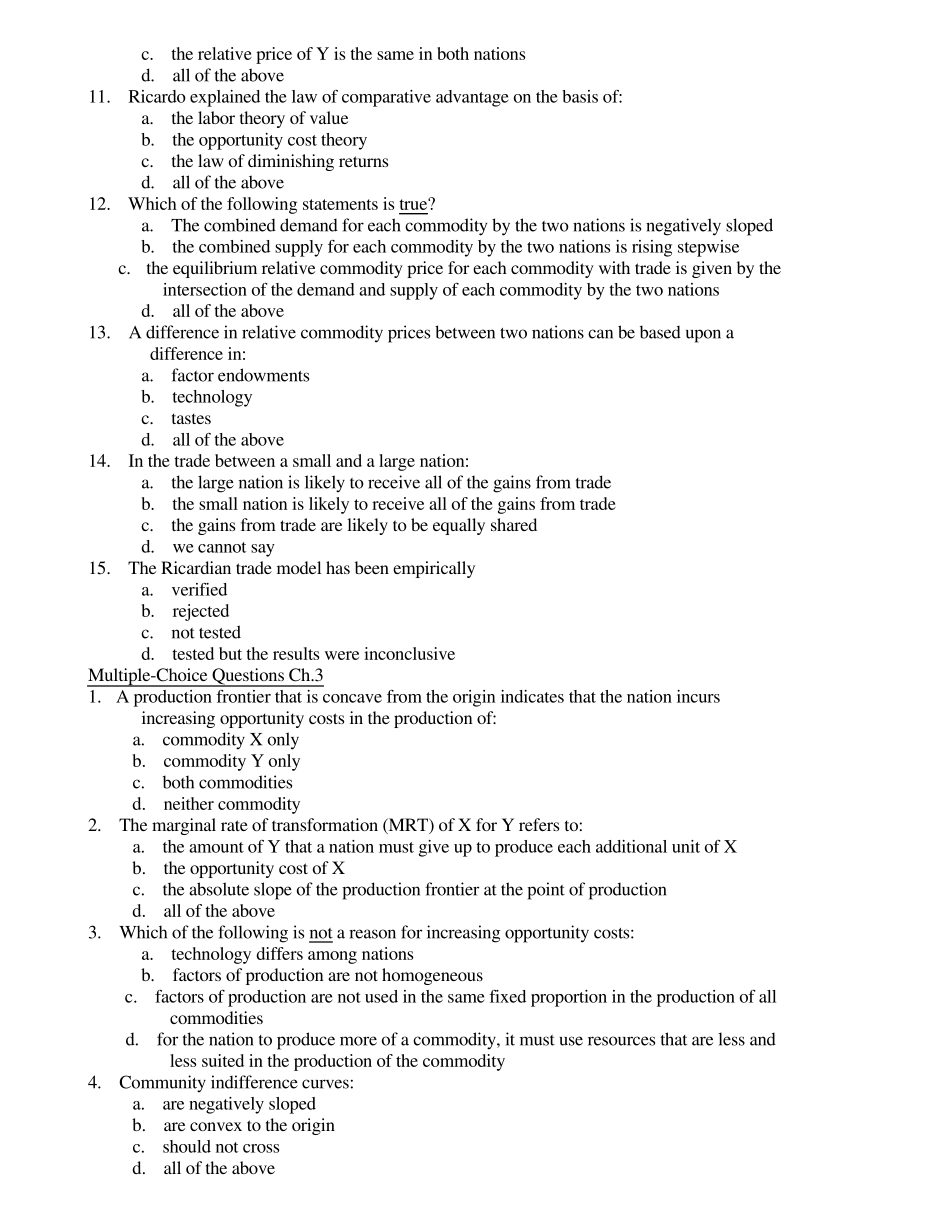
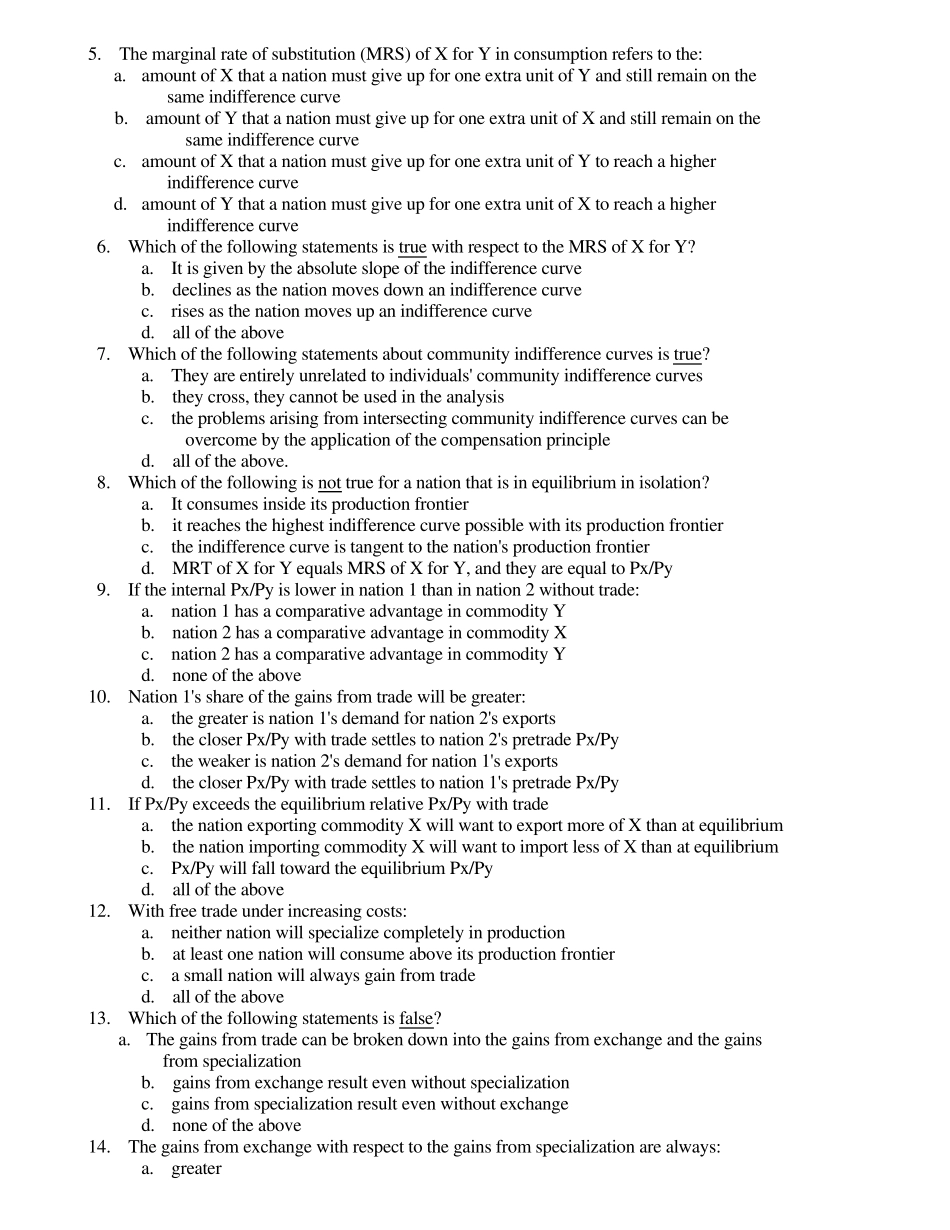
Multiple-Choice Questions Ch.2 1. The Mercantilists did not advocate: a. free trade b. stimulating the nation's exports c. restricting the nations' imports d. the accumulation of gold by the nation 2. According to Adam Smith, international trade was based on: a. absolute advantage b. comparative advantage c. both absolute and comparative advantage d. neither absolute nor comparative advantage 3. What proportion of international trade is based on absolute advantage? a. All b. most c. some d. none 4. The commodity in which the nation has the smallest absolute disadvantage is the commodity of its: a. absolute disadvantage b. absolute advantage c. comparative disadvantage d. comparative advantage 5. If in a two-nation (A and B), two-commodity (X and Y) world, it is established that nation A has a comparative advantage in commodity X, then nation B must have: a. an absolute advantage in commodity Y b. an absolute disadvantage in commodity Y c. a comparative disadvantage in commodity Y d. a comparative advantage in commodity Y 6. If with one hour of labor time nation A can produce either 3X or 3Y while nation B can produce either 1X or 3Y (and labor is the only input): a. nation A has a comparative disadvantage in commodity X b. nation B has a comparative disadvantage in commodity Y c. nation A has a comparative advantage in commodity X d. nation A has a comparative advantage in neither commodity 7. With reference to the statement in Question 6: a. Px/Py=1 in nation A b. Px/Py=3 in nation B c. Py/Px=1/3 in nation B d. all of the above 8. With reference to the statement in Question 6, if 3X is exchanged for 3Y: a. nation A gains 2X b. nation B gains 6Y c. nation A gains 3Y d. nat...