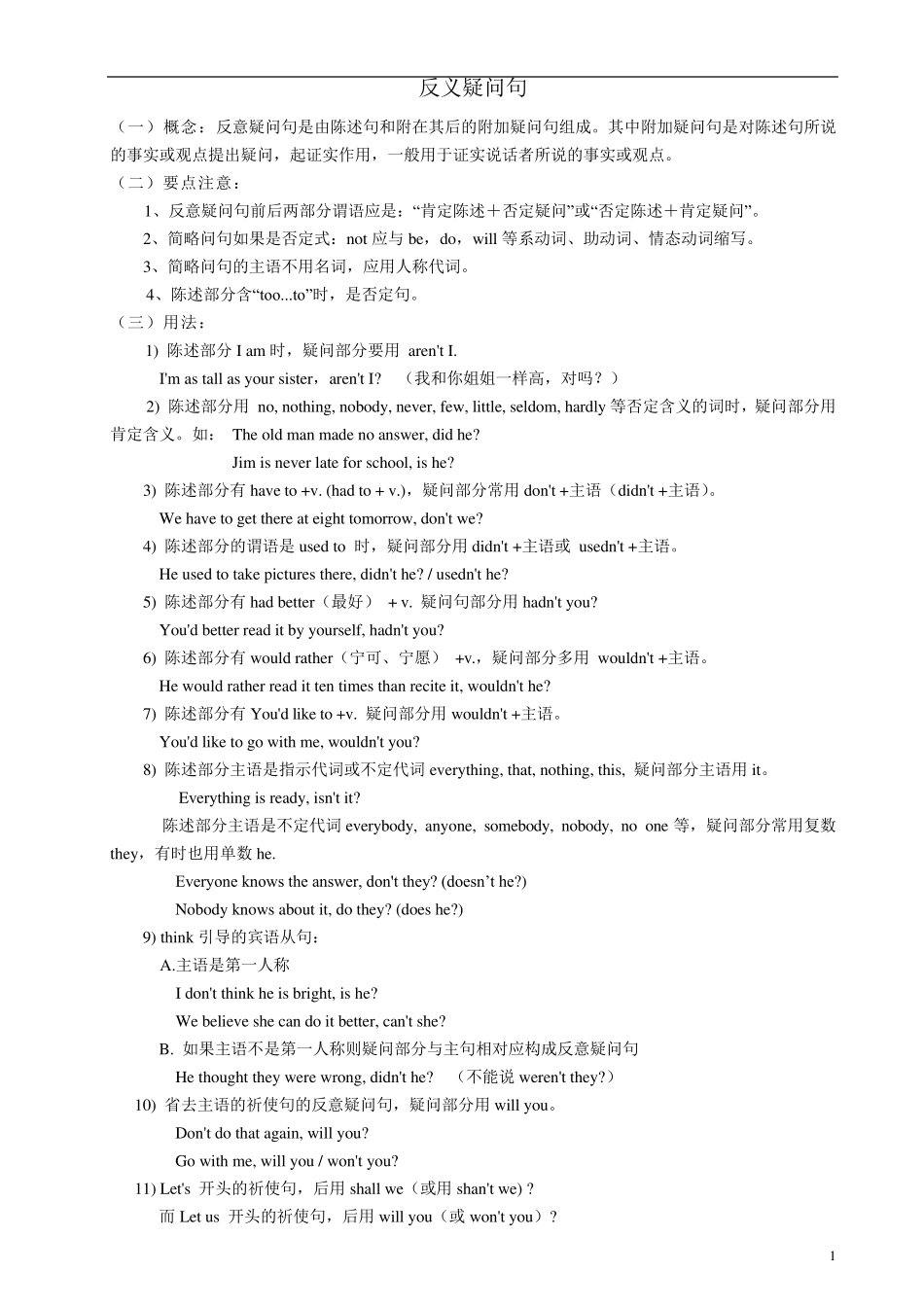
1 反义疑问句 (一)概念:反意疑问句是由陈述句和附在其后的附加疑问句组成
其中附加疑问句是对陈述句所说的事实或观点提出疑问,起证实作用,一般用于证实说话者所说的事实或观点
(二)要点注意: 1、反意疑问句前后两部分谓语应是:“肯定陈述+否定疑问” 或“否定陈述+肯定疑问”
2、简略问句如果是否定式:not 应与 be,do,will 等系动词、助动词、情态动词缩写
3、简略问句的主语不用名词,应用人称代词
4、陈述部分含“too
to” 时,是否定句
(三)用法: 1) 陈述部分 I am 时,疑问部分要用 aren't I
I'm as tall as your sister,aren't I
(我和你姐姐一样高,对吗
) 2) 陈述部分用 no, nothing, nobody, never, few, little, seldom, hardly等否定含义的词时,疑问部分用肯定含义
如: The old man made no answer, did he
Jim is never late for school, is he
3) 陈述部分有 have to +v
(had to + v
),疑问部分常用don't +主语(didn't +主语)
We have to get there at eight tomorrow, don't we
4) 陈述部分的谓语是used to 时,疑问部分用didn't +主语或 usedn't +主语
He used to take pictures there, didn't he
/ usedn't he
5) 陈述部分有 had better(最好) + v
疑问句部分用hadn&#