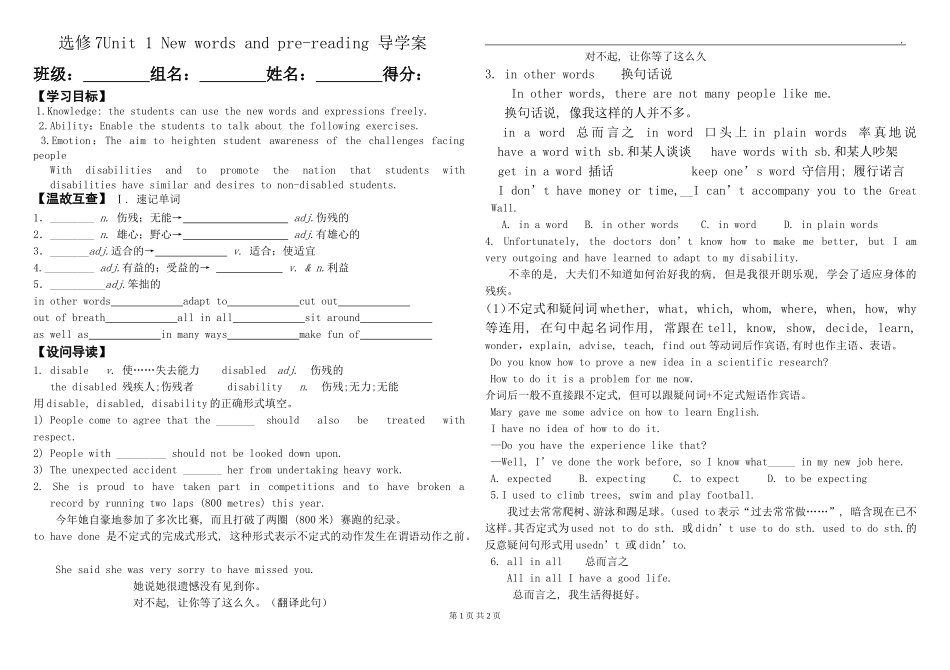
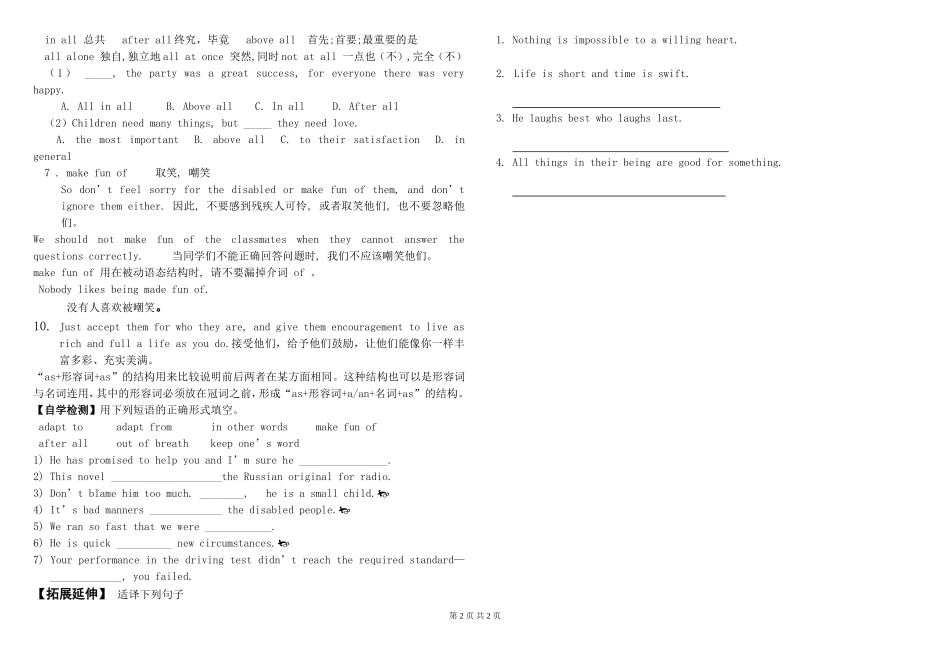
第1页共2页选修7Unit1Newwordsandpre-reading导学案班级:组名:姓名:得分:【学习目标】1.Knowledge:thestudentscanusethenewwordsandexpressionsfreely.2.Ability:Enablethestudentstotalkaboutthefollowingexercises.3.Emotion:TheaimtoheightenstudentawarenessofthechallengesfacingpeopleWithdisabilitiesandtopromotethenationthatstudentswithdisabilitieshavesimilaranddesirestonon-disabledstudents.【温故互查】Ⅰ.速记单词1.________n.伤残;无能→adj.伤残的2.________n.雄心;野心→adj.有雄心的3._______adj.适合的→v.适合;使适宜4._________adj.有益的;受益的→v.&n.利益5.__________adj.笨拙的inotherwordsadapttocutoutoutofbreathallinallsitaroundaswellasinmanywaysmakefunof【设问导读】1.disablev.使……失去能力disabledadj.伤残的thedisabled残疾人;伤残者disabilityn.伤残;无力;无能用disable,disabled,disability的正确形式填空。1)Peoplecometoagreethatthe_______shouldalsobetreatedwithrespect.2)Peoplewith_________shouldnotbelookeddownupon.3)Theunexpectedaccident_______herfromundertakingheavywork.2.Sheisproudtohavetakenpartincompetitionsandtohavebrokenarecordbyrunningtwolaps(800metres)thisyear.今年她自豪地参加了多次比赛,而且打破了两圈(800米)赛跑的纪录。tohavedone是不定式的完成式形式,这种形式表示不定式的动作发生在谓语动作之前。Shesaidshewasverysorrytohavemissedyou.她说她很遗憾没有见到你。对不起,让你等了这么久。(翻译此句).对不起,让你等了这么久3.inotherwords换句话说Inotherwords,therearenotmanypeoplelikeme.换句话说,像我这样的人并不多。inaword总而言之inword口头上inplainwords率真地说haveawordwithsb.和某人谈谈havewordswithsb.和某人吵架getinaword插话keepone’sword守信用;履行诺言Idon’thavemoneyortime,__Ican’taccompanyyoutotheGreatWall.A.inawordB.inotherwordsC.inwordD.inplainwords4.Unfortunately,thedoctorsdon’tknowhowtomakemebetter,butIamveryoutgoingandhavelearnedtoadapttomydisability.不幸的是,大夫们不知道如何治好我的病,但是我很开朗乐观,学会了适应身体的残疾。(1)不定式和疑问词whether,what,which,whom,where,when,how,why等连用,在句中起名词作用,常跟在tell,know,show,decide,learn,wonder,explain,advise,teach,findout等动词后作宾语,有时也作主语、表语。Doyouknowhowtoproveanewideainascientificresearch?Howtodoitisaproblemformenow.介词后一般不直接跟不定式,但可以跟疑问词+不定式短语作宾语。MarygavemesomeadviceonhowtolearnEnglish.Ihavenoideaofhowtodoit.—Doyouhavetheexperiencelikethat?—Well,I’vedonetheworkbefore,soIknowwhat_____inmynewjobhere.A.expectedB.expectingC.toexpectD.tobeexpecting5.Iusedtoclimbtrees,swimandplayfootball.我过去常常爬树、游泳和踢足球。(usedto表示“过去常常做……”,暗含现在已不这样。其否定式为usednottodosth.或didn’tusetodosth.usedtodosth.的反意疑问句形式用usedn’t或didn’to.6.allinall总而言之AllinallIhaveagoodlife.总而言之,我生活得挺好。第2页共2页inall总共afterall终究,毕竟aboveall首先;首要;最重要的是allalone独自,独立地allatonce突然,同时notatall一点也(不),完全(不)(1)_____,thepartywasagreatsuccess,foreveryonetherewasveryhappy.A.AllinallB.AboveallC.InallD.Afterall(2)Childrenneedmanythings,but_____theyneedlove.A.themostimportantB.aboveallC.totheirsatisfactionD.ingeneral7.makefunof取笑,嘲笑Sodon’tfeelsorryforthedisabledormakefunofthem,anddon’tignorethemeither.因此,不要感到残疾人可怜,或者取笑他们,也不要忽略他们。Weshouldnotmakefunoftheclassmateswhentheycannotanswerthequestionscorrectly.当同学们不能正确回答问题时,我们不应该嘲笑他们。makefunof用在被动语态结构时,请不要漏掉介词of。Nobodylikesbein...