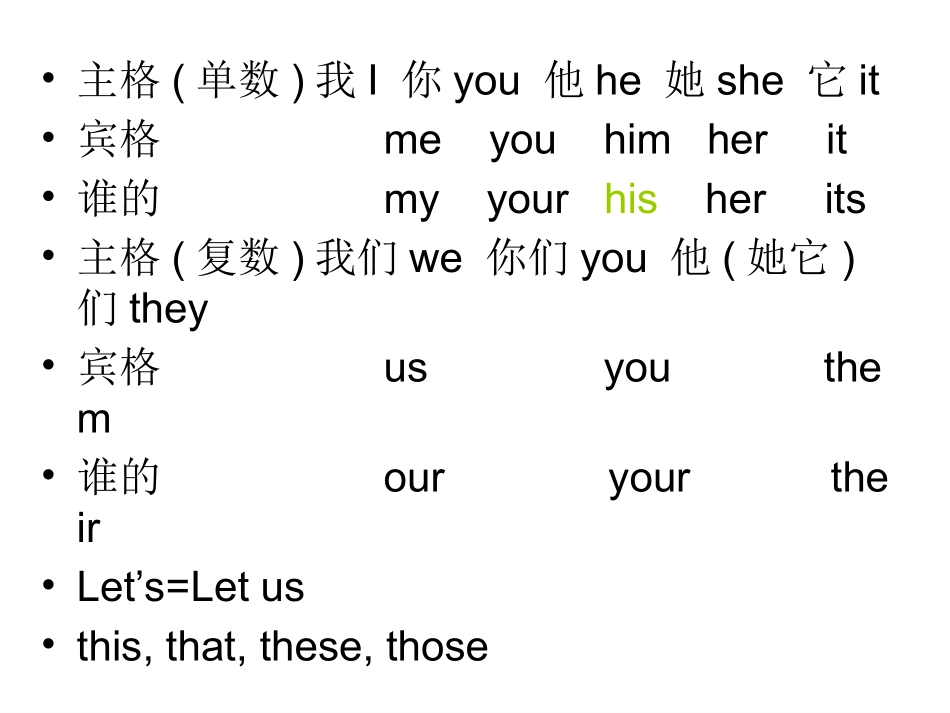
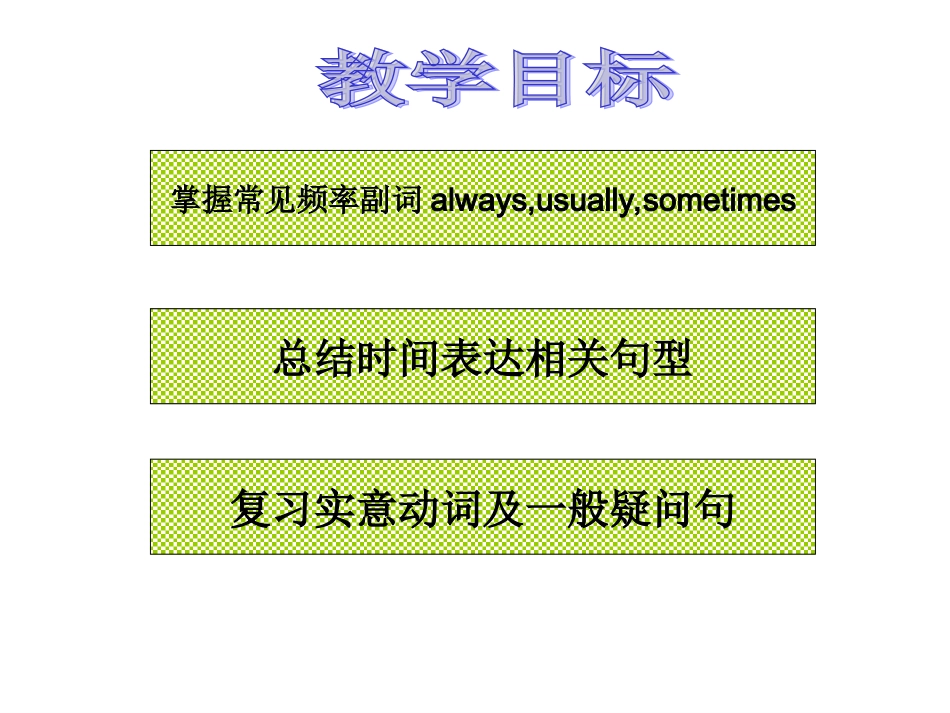
•主格(单数)我I你you他he她she它it•宾格meyouhimherit•谁的myyourhisherits•主格(复数)我们we你们you他(她它)们they•宾格usyouthem•谁的ouryourtheir•Let’s=Letus•this,that,these,those掌握常见频率副词always,usually,sometimes总结时间表达相关句型复习实意动词及一般疑问句词汇always/':lweizɔ/总是usually/'ju:uəlʒi/通常rice/rais/水稻;米饭early/'ə:li/早的sunlight/snlaitʌ/阳光wake/weik/醒来wakeup醒来,唤醒exercise/'eksəsaiz/练习,体操kitchen/'kitinʃ/厨房anyone/'eniwnʌ/任何人wrong/rŋɔ/错误的right/rait/词组•醒来wakeup•做早操domorningexercises•do助动词(没有意义)•实意动词(做,干)语法•频率副词usually,always,sometimes常用于一般现在时的句中,常放在实意动词前,be动词后。强调时也可放在句首。•如:Ialwayshavelunchattwelve.•Heusuallyhasbreakfastatseven.have表示“吃”•have+三餐•吃早餐havebreakfast•吃午餐havelunch•吃晚餐havesupper•例句:我通常七点吃早饭。•Iusuallyhavebreakfastatseven.have+食物+for+三餐•表达早餐吃什么•固定句型:人+have/has(吃)+食物+for+三餐.•Ihaveeggsandmilkforbreakfast.•我早餐吃鸡蛋和牛奶。•1.我早餐吃面包和两个西红柿。tomato•2.他午餐吃面条。noodle•Ihavebreadandtwotomatoesforbreakfast.•Hehasnoodlesforlunch.1.It’stimefor/to•It’stimefor+名词•It’stimeto+动词原形•…的时间到了;该….•吃早餐的时间到了(该吃早餐了)•It’stimeforbreakfast.•It’stimetohavebreakfast.•late[leit]迟的,晚的2.havenotimefor/to•havenotimefor+名词•havenotimeto+动词•没有时间做某事•我没有时间吃早餐。•Ihavenotimeforbreakfast.•Ihavenotimetohavebreakfast.练习1.我总是在7点起床。2.他通常在9点睡觉。3.她总是迟到。4.该吃午饭了(用两种)5.我没有时间踢足球。6.我晚餐吃米饭。7.你经常迟到吗?8.他经常六点起床吗?•Ialwaysgetup/wakeupatseven.•Heusuallysleeps/goestobedatnine.•Sheisalwayslate.•It’stimeforlunch.It’stimetohavelunch.Ihavenotimetoplayfootball.Areyouoftenlate?DoeshealwaysgetupatSix?变一般疑问句•1.Thereisabookinthebag.•2.Ihaveabook.•3.Helikesmusic.•4.Theyplayfootball.•含有实意动词的句子变一般疑问句,分两种情况1.不是第三人称单数的,直接在开头加上do,2.是第三人称单数的,前加does,后去s,(前面打死,后面去死)•Isthereabookinthebag?•含有be动词的句子,变一般疑问句,把be动词提到句子开头。•Doyouhaveabook?•Doeshelikemusic?•Dotheyplayfootball?重点句1.Doyoualwayshavelunchattwelve?Yes,Ido.2.Iusuallyhavelunchateleventhirty.3.It’searlyinthemorning.ThesunlightgoesoninJohn’sroom.Johnwakesup.4.Ihavenotimetodomorningexercises.9.3作业•单词抄三默一。•课文会读,会翻译。•翻译句子。•我早餐吃两个香蕉,一个苹果。(banana)•她午餐吃鸡蛋和大米。