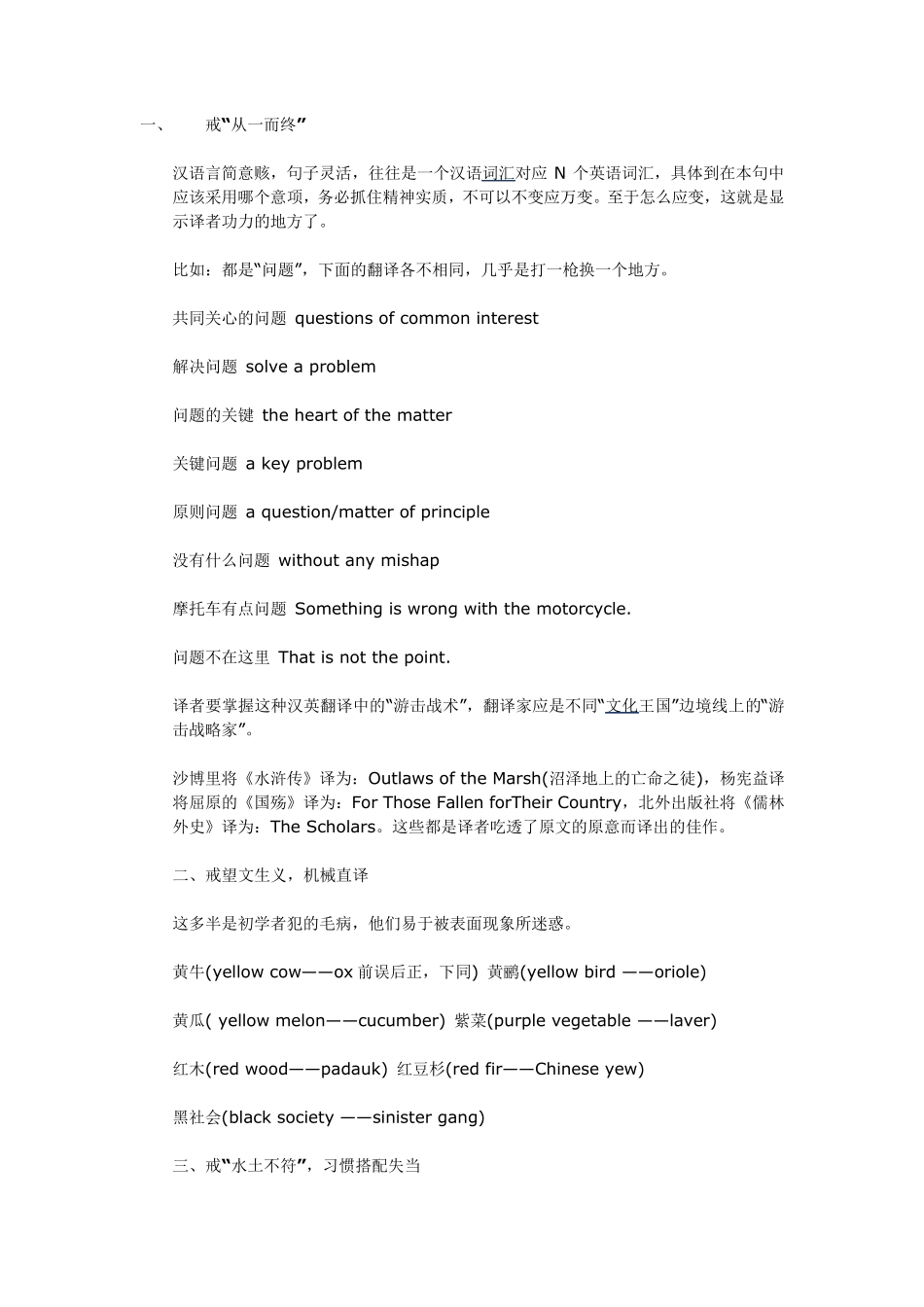
一、 戒“从一而终” 汉语言简意赅,句子灵活,往往是一个汉语词汇对应 N 个英语词汇,具体到在本句中应该采用哪个意项,务必抓住精神实质,不可以不变应万变
至于怎么应变,这就是显示译者功力的地方了
比如:都是“问题” ,下面的翻译各不相同,几乎是打一枪换一个地方
共同关心的问题 questions of common interest 解决问题 solve a problem 问题的关键 the heart of the matter 关键问题 a key problem 原则问题 a question/matter of principle 没有什么问题 without any mishap 摩托车有点问题 Something is wrong with the motorcycle
问题不在这里 That is not the point
译者要掌握这种汉英翻译中的“游击战术” ,翻译家应是不同“文化王国” 边境线上的“游击战略家”
沙博里将《水浒传》译为:Outlaws of the Marsh(沼泽地上的亡命之徒),杨宪益译将屈原的《国殇》译为:For Those Fallen forTheir Country,北外出版社将《儒林外史》译为:The Scholars
这些都是译者吃透了原文的原意而译出的佳作
二、戒望文生义,机械直译 这多半是初学 者犯 的毛 病 ,他 们 易 于被 表 面现 象 所 迷 惑
黄 牛 (yellow cow— — ox 前 误 后 正 ,下同) 黄 鹂 (yellow bird — — oriole) 黄 瓜 ( yellow melon— — cucumber) 紫 菜 (purple vegetable — — laver) 红 木 (red wood— — padauk) 红 豆 杉 (red fir— — Ch