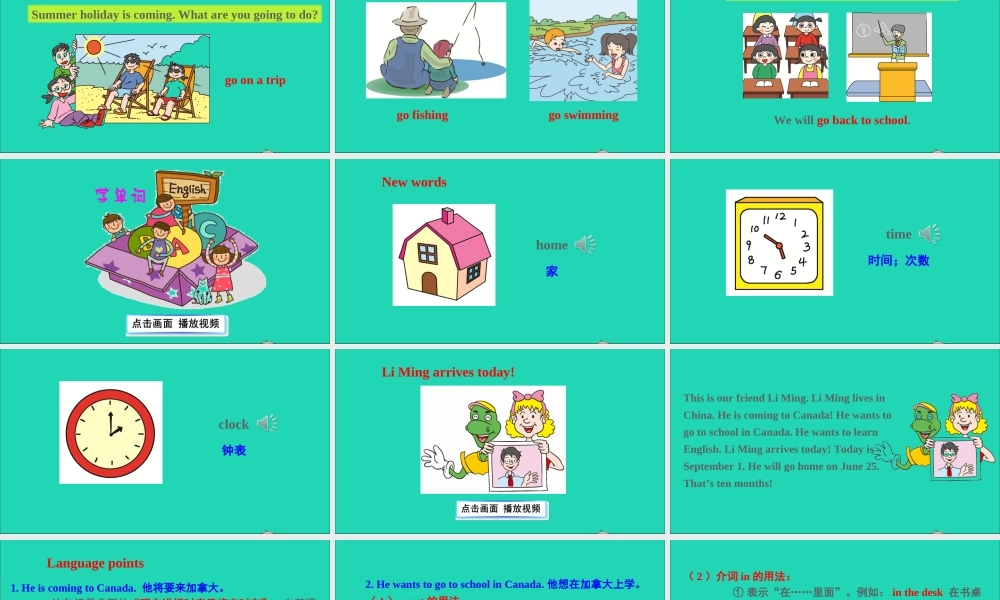
Unit 1 Li Ming goes to CanadaLesson 1Lead-ingo on a tripSummer holiday is coming
What are you going to do
go fishinggo swimmingBut on September 1, what will you do
We will go back to school
New wordshome家time时间;次数clock钟表Li Ming arrives today
This is our friend Li Ming
Li Ming lives in China
He is coming to Canada
He wants to go to school in Canada
He wants to learn English
Li Ming arrives today
Today is September 1
He will go home on June 25
That’s ten months
Language points1
He is coming to Canada
他将要来加拿大
这句话是典型的“现在进行时表示将来时态”
在英语中有 4 个动词可以使用“现在进行时表将来”,它们是 come(来)、 go (去)、 leave (离开)、 arrive (到达)
【例句】 He is leaving tomorrow
他明天将离开
【例句】 Tom is arriving in two days
汤姆将在两天后到达
He wants to go to school in Canada
他想在加拿大上学
( 1 ) want 的用法: ①want + 名词,表示想要某物
【例句】 I want some wat