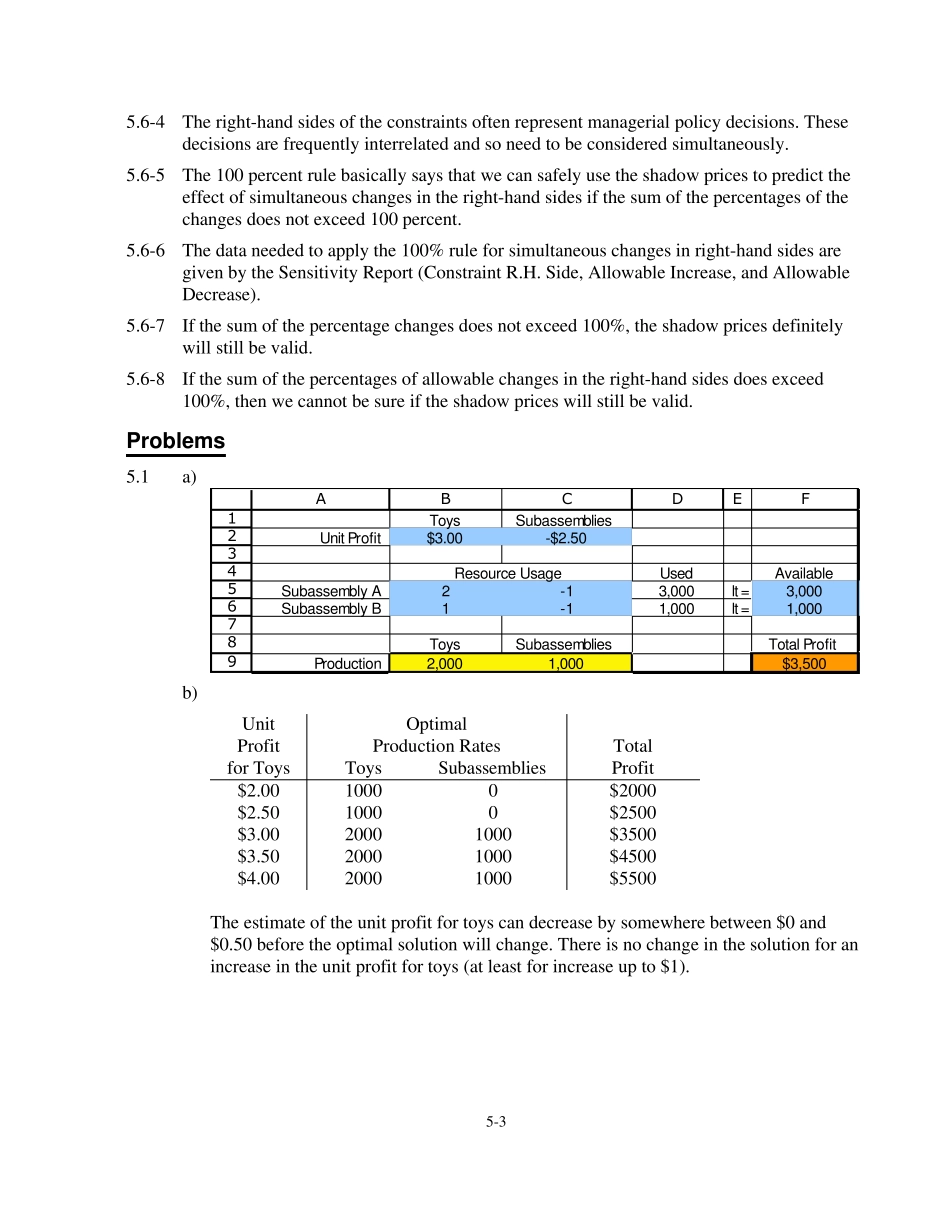
5-1 CHAPTER 5 WHAT-IF ANALYSIS FOR LINEAR PROGRAMMING Review Questions 5.1-1 The parameters of a linear programming model are the constants (coefficients or right-hand sides) in the functional constraints and the objective function. 5.1-2 Many of the parameters of a linear programming model are only estimates of quantities that cannot be determined precisely and thus result in inaccuracies. 5.1-3 What-if analysis reveals how close each of these estimates needs to be to avoid obtaining an erroneous optimal solution, and therefore pinpoints the sensitive parameters where extra care is needed to refine their estimates. 5.1-4 No, if the optimal solution will remain the same over a wide range of values for a particular coefficient, then it may be appropriate to make only a fairly rough estimate for a parameter of a model. 5.1-5 Conditions that impact the parameters of a model, such as unit profit, may change over time and render them inaccurate. 5.1-6 If conditions change, what-if analysis leaves signposts that indicate whether a resulting change in a parameter of the model changes the optimal solution. 5.1-7 Sensitivity analysis is studying how changes in the parameters of a linear programming model affect the optimal solution. 5.1-8 What-if analysis provides guidance about what the impact would be of altering policy decisions that are represented by parameters of a model. 5.2-1 The estimates of the unit profits for the two products are most questionable. 5.2-2 The number of hours of production time that is being made available per week in the three plants might change after analysis. 5.3-1 The allowable range for a coefficient in the objective function is the range of values over which the optimal...