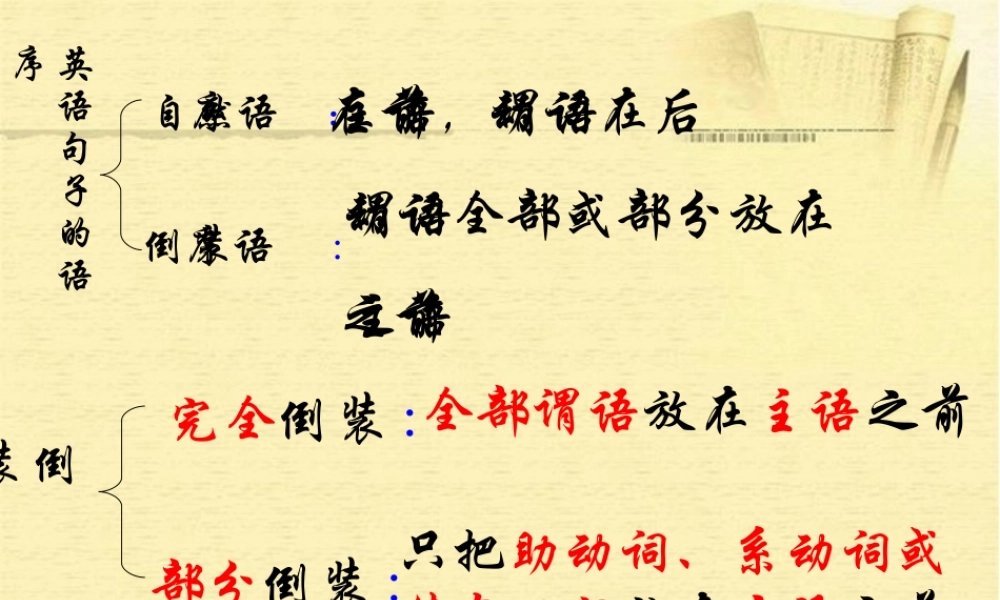
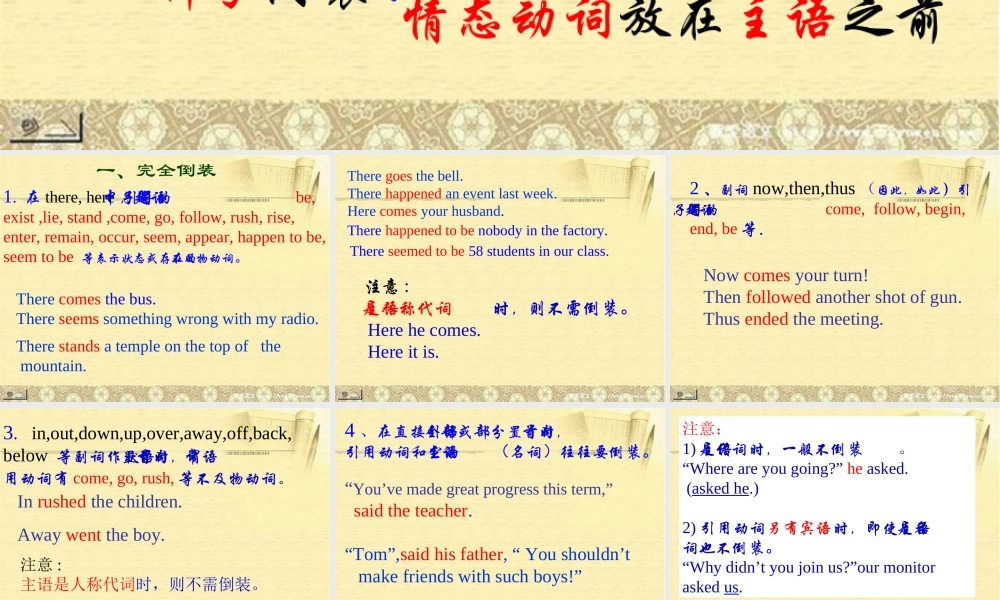
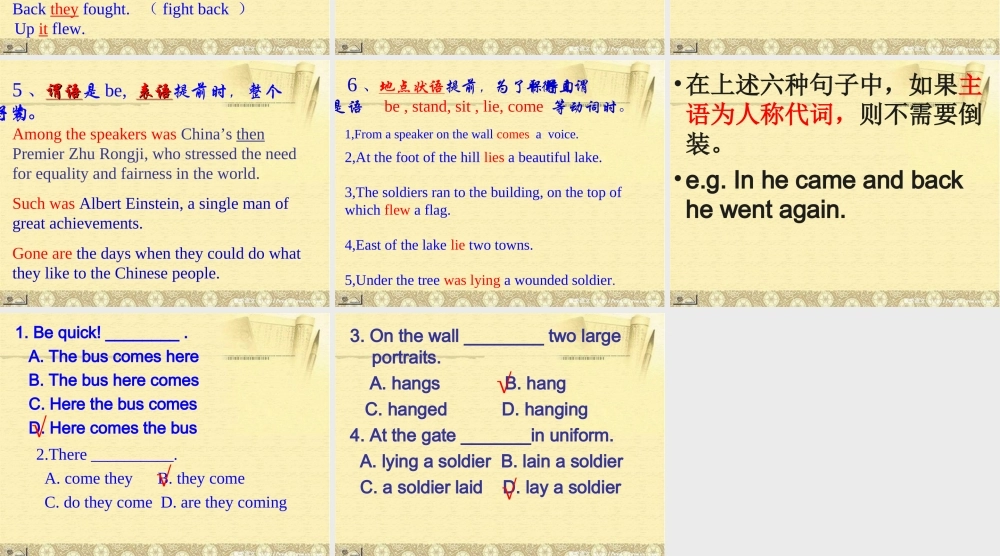
英语句子的语序自然语序:倒装语序:主语在前,谓语动词在后谓语动词全部或部分放在主语之前完全倒装 :部分倒装 : 全部谓语放在主语之前只把助动词、系动词或情态动词放在主语之前倒装一、完全倒装1. 在 there, here 引导的句子中,谓语是 be, exist ,lie, stand ,come, go, follow, rush, rise, enter, remain, occur, seem, appear, happen to be, seem to be 等表示状态或存在的不及物动词。 There comes the bus. There seems something wrong with my radio. There stands a temple on the top of the mountain.There goes the bell. There happened an event last week.Here comes your husband.注意 :主语是人称代词时,则不需倒装。 Here he comes. Here it is.There happened to be nobody in the factory.There seemed to be 58 students in our class.2 、副词 now,then,thus (因此,如此)引导的句子里,谓语是come, follow, begin, end, be 等.Now comes your turn!Then followed another shot of gun.Thus ended the meeting.3. in,out,down,up,over,away,off,back,below 等副词作状语置于句首时,谓语常用动词有 come, go, rush, 等不及物动词。In rushed the children. Away went the boy. 注意 :主语是人称代词时,则不需倒装。Back they fought. ( fight back ) Up it flew..4 、在直接引语全部或部分置于句首时,引用动词和它的主语(名词)往往要倒装。“You’ve made great progress this term,” said the teacher.“Tom”,said his father, “ You shouldn’t make friends with such boys!”注意:1) 主语是代词时,一般不倒装。“Where are you going?” he asked. (asked he.)2) 引用动词另有宾语时,即使主语是名词也不倒装。“Why didn’t you join us?”our monitor asked us.5 、谓语谓语是 be, 表语表语提前时,整个句子需倒装。Among the speakers was China’s then Premier Zhu Rongji, who stressed the need for equality and fairness in the world.Such was Albert Einstein, a single man of great achievements.Gone are the days when they could do what they like to the Chinese people.6 、地点状语提前,为了保持句子平衡且谓语是be , stand, sit , lie, come 等动词时。1,From a speaker on the wall comes a voice.2,At the foot of the hill lies a beautiful lake. 3,The soldiers ran to the building, on the top of which flew a flag. 4,East of the lake lie two towns. 5,Under the tree was lying a wounded soldier. • 在上述六种句子中,如果主语为人称代词,则不需要倒装。 • e.g. In he came and back he went again. 1. Be quick! ________ . A. The bus comes here B. The bus here comes C. Here the bus comes D. Here comes the bus√2.There __________. A. come they B. they come C. do they come D. are they coming√3. On the wall ________ two large portraits. A. hangs B. hang C. hanged D. hanging 4. At the gate _______in uniform. A. lying a soldier B. lain a soldier C. a soldier laid D. lay a soldier√√